
From Invisible to AI Authority: How Novotel Singapore on Stevens Redefined Digital Visibility in 90 Days
Prudence Marzinotto
From Invisible to AI Authority: How Novotel Singapore on Stevens Redefined Digital Visibility in 90 Days
When travellers ask ChatGPT where to stay, the answers don’t come from search results, they come from belief. In those moments, if AI doesn’t recognise your brand, you don’t just lose visibility, you lose opportunity. That’s where Novotel Singapore on Stevens began, almost invisible. Ninety days later, it became one of Singapore’s most AI-cited hotels. The secret? Data that made AI trust them.
From “family hotels near Orchard Road” to “best wedding venues in Singapore,” AI models now reference the hotel naturally and accurately, not because of luck or ad spend, but because the data made them believe.
Powered by AI Source, Novotel’s digital ecosystem evolved from a static SEO structure into an AI-recognised authority in under 90 days.
The Visibility Curve: Building AI Recognition from the Ground Up
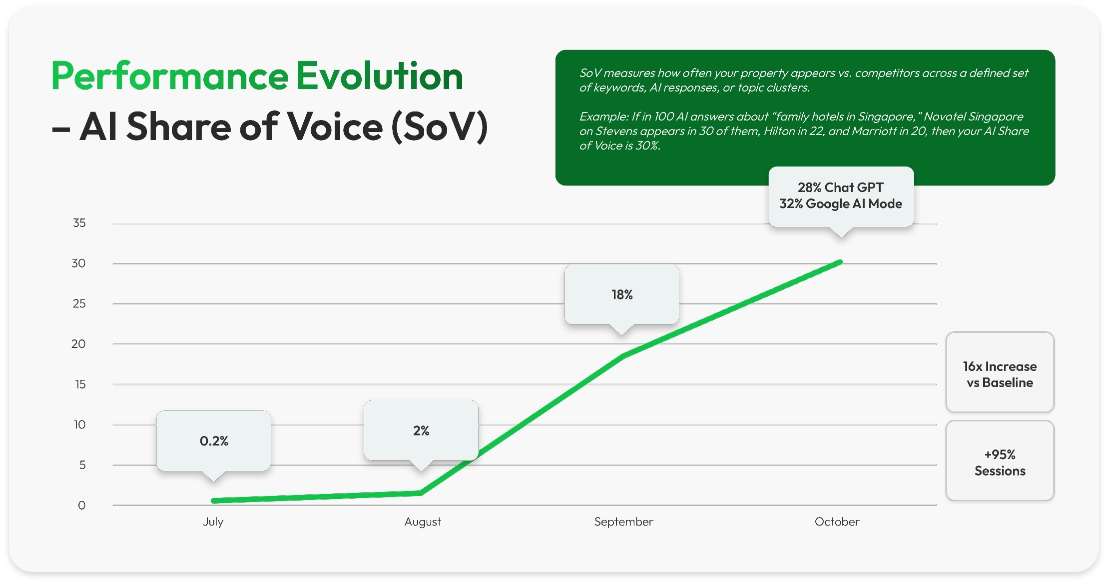
When the AI Source program began, Novotel’s Share of Voice (SoV), the measure of how often a brand appears in AI-generated answers hovered between 0.2% and 2%. Practically invisible.
Within 90 days, that number skyrocketed to 28% in ChatGPT and 32% in Google AI Mode, a 16× increase from baseline. By October, the property wasn’t just catching up; it was leading. It had surpassed iconic competitors like Marina Bay Sands (10.6%), The Fullerton (25%) and Mandarin Oriental (14.5%), setting a new benchmark for Accor hotels in AI visibility.
Both ChatGPT and Google AI began associating Novotel with the right categories, family stays, weddings, and urban escapes. When an algorithm starts describing your brand the way your guests do, you’ve achieved something deeper than search rankings. You’ve achieved semantic alignment the moment AI truly understands your story.
Trust Signals: The Hidden Currency of AI Visibility
Visibility without credibility is just noise. The turning point for Novotel came when its digital ecosystem began signalling trust.
During the 90-day pilot, the hotel maintained a consistently positive sentiment score of 70–75%, while its SEO technical score hit 98/100, and its authority score reached 69. Over 1,000 new backlinks strengthened the site’s digital reputation, giving AI systems the equivalent of glowing character references.
In traditional SEO, backlinks nudge rankings. In AI search, they anchor trust. They tell the algorithm, “This is a reliable, expert source worth citing.”
It’s no coincidence that once those signals matured, both ChatGPT and Google AI started mentioning Novotel confidently and repeatedly, not as a random result, but as a trusted answer.
The Power of Context: Competing Beyond the Brand
One of the most striking outcomes came in September, when Novotel generated 4,500 non-brand organic sessions. These weren’t travellers searching for “Novotel.” They were people discovering the property through broader, high-intent searches like “family hotel Singapore” or “wedding venue near Orchard Road.”
That’s the difference between being found and being chosen.
This shift marked Novotel’s entry into the conversations shaping traveller intent, the spaces where decisions begin. Through AI Source, the property stopped relying solely on brand loyalty and started capturing new market share through discovery.
That’s what Answer Engine Optimisation (AEO) is built for: making brands visible in the evolving conversations that define visibility today, not just the search boxes of yesterday.
Quality Over Quantity: When Traffic Finally Means Something
Many hotels celebrate when web sessions spike. But Novotel’s AI Source pilot revealed a deeper truth, not all traffic is created equal.
Over the 90-day period, overall site events decreased slightly (–5.8%), yet revenue actions increased by 1.5%. In other words, fewer people were browsing but more were booking.
That’s the quiet power of AI-optimised visibility. It doesn’t just attract visitors; it aligns discovery with intent. AI Source didn’t flood the site with noise. It filtered for relevance, bringing in travellers who were already close to a decision.
This is the kind of data that marketing teams dream of: fewer wanderers, more conversions, stronger intent.
Beyond Visibility: When AI Understands Your Brand
The biggest breakthrough wasn’t just about being seen more often. It was about being understood more accurately.
By the end of the pilot, AI models weren’t just mentioning Novotel Singapore on Stevens, they were describing it exactly as the brand intended:
“Family-friendly amenities.”
“Tranquil urban resort.”
“Sustainability-focused.”
Those aren’t keywords stuffed into metadata. They’re the product of consistent content architecture, structured data, and a clearly defined narrative that AI could read, parse, and summarise.
When language models begin to mirror your own brand language without prompting, it signals a new level of digital maturity. The brand has become prompt-ready: prepared not just for search queries, but for the future of conversational discovery.
That’s the difference between awareness and understanding. Awareness makes you visible. Understanding makes you trusted.
Lessons for the Industry: What Every Hotel Can Learn
The Novotel Singapore on Stevens journey holds lessons for hotels everywhere — not just about strategy, but about how digital visibility itself has evolved.
1. AI Search Is Now a Visibility Channel
AI isn’t a side experiment. It’s where travellers are making decisions. If your brand isn’t being mentioned by AI systems, it’s invisible to a growing share of your market.
2.Trust Beats Traffic
A high SEO score, strong authority, and consistent sentiment are the new trifecta of visibility. The most valuable exposure isn’t the widest — it’s the most credible.
3.Brand Clarity Wins
AI can’t amplify what it doesn’t understand. The clearer and more structured your narrative, the easier it is for algorithms to align with it.
4.Performance Is Multi-Dimensional
Visibility today can’t be measured by page rankings alone. It’s a blend of Share of Voice (SoV), sentiment, and conversion quality. Together, they tell a more complete story of brand health and digital equity.
This isn’t about chasing clicks. It’s about earning presence in the spaces where decisions are made, the new frontlines of visibility.
Looking Ahead: From AI Source Pilot to Playbook
In just 90 days, Novotel Singapore on Stevens didn’t just grow its AI presence, it redefined what “discoverability” means in 2025.
The results are undeniable:
- 16× increase in Share of Voice
- 95% growth in sessions
- Category dominance in long-tail AI results
- Sustained brand sentiment of 70–75%
- Revenue actions up 1.5% despite fewer overall site events
But the real win wasn’t in the numbers, it was in alignment. AI now recognises Novotel the same way travellers do. It understands the brand’s essence and communicates it faithfully across every digital touchpoint.
That’s not just visibility. That’s credibility.
AI Source didn’t just optimise Novotel’s content, it rewired how AI understood the brand. And in 2025, that’s not marketing innovation. It’s survival.
For hotels navigating an AI-driven search landscape, Novotel’s journey signals the new playbook:
- Stop optimising for algorithms.
- Start communicating with them.
Because the future of hospitality marketing won’t be about who shouts loudest, it’ll be about who the algorithms trust to tell the story best.
AI isn’t replacing search. It’s redefining who gets seen first.
And as Novotel Singapore on Stevens proved, when you make AI understand, and believe, in your brand, everything changes.

Prudence Marzinotto

Spicing up the
BOTTOM LINE.
+$620,779
Achieved in the first 12-months. 17xROI
“We have seen an increase in external capture during both lunch and dinner, with external covers now contributing close to 70% of Boda’s capture.”

ZAC LUMSDEN
General Manager
Pullman Auckland Hotel & Apartments