
Transforming Crowne Plaza Hobart
How to Choose an AI Search Provider for Your Hotel: A Practical Guide for GMs, DOSMs and Commercial Directors
Michael MacDonald, Director, OmniHyper
May 29, 2026
15 MIN READ
How to Choose an AI Search Provider for Your Hotel: A Practical Guide for GMs, DOSMs and Commercial Directors
The market for AI search services has grown fast. Hotel teams are now being approached by a range of providers, from specialist hospitality agencies to broad digital marketing firms, from established names to new entrants, all offering some version of AEO (Answer Engine Optimisation) or GEO (Generative Engine Optimisation).
For a General Manager, DOSM or Commercial Director, evaluating these options is genuinely difficult. The terminology is new. The claims are bold. And the pricing varies enormously, which makes it tempting to use cost as the primary filter.
This guide is designed to give hotel teams a practical framework for making this decision well, one that goes beyond price, asks the right questions, and connects the choice to what actually matters: commercial outcomes for your property.
First, Understand What You Are Actually Buying
Before you evaluate any provider, it helps to understand what AI search optimisation actually is, and what it is not.
AI search optimisation is the work of ensuring that when guests use tools like Google AI Overviews, Google AI Mode, ChatGPT, Microsoft Copilot, Perplexity, or voice assistants to find a hotel, your property is the answer they receive. It is not traditional SEO with a new name. It operates on entirely different signals: semantic relevance, entity authority, structured data, and citation quality. Where traditional SEO is about ranking for keywords, AI search is about being trusted enough, and structured clearly enough, for an AI platform to recommend your property by name.
The critical point is this: AI search is not a technical problem you solve once and move on from.
The platforms your guests use don’t take a snapshot of the hotel landscape and hold it fixed. They update continuously. Competitor content changes. New properties open. Demand patterns shift. Events drive local search intent. What is accurate about your property’s AI visibility today will drift without active maintenance.
This means there are, in practical terms, two fundamentally different things being sold in this market right now. Understanding the difference is the most important step in making a good decision.
A once-off foundations package completes a set of technical optimisations, structured data, schema markup, entity cleanup, initial content updates, and delivers a before-and-after report. It addresses your visibility gaps at a point in time. The work ends when the package is delivered.
An ongoing AI search program builds and maintains your property’s AI visibility continuously. It refines content and strategy as AI platforms evolve, monitors how your hotel is being cited across platforms, tracks competitor positioning, and actively steers AI recommendations toward direct booking outcomes. It doesn’t end. It compounds.
A once-off package is a static map of where you stand today. An ongoing program is the engine that keeps you ahead as the road changes.
Neither is without value, but they are not the same product, and they should not be compared as if they were.
The Criteria That Actually Matter
Once you understand the difference between a point-in-time fix and an ongoing program, the evaluation framework becomes much clearer.
1.Specialist in Hospitality, or Generalist?
AI search for hotels is not the same as AI search for retail, financial services, or e-commerce. It requires an understanding of how guests discover and book accommodation, how revenue is generated across rooms, F&B, MICE, weddings and spa, how OTA dynamics affect the commercial case for direct bookings, and how brand standards interact with a hotel’s digital presence.
An agency that works across multiple industries will apply a generic framework. A hospitality specialist will bring accumulated, sector-specific knowledge that shapes every decision, from how content is structured to how success is measured.
Ask any provider: what percentage of your clients are hotels? What specific hospitality brands and property types have you worked with? Can you show results from hotel properties, not just general case studies?
2. Track Record, With Hotels, Not Just in Digital Marketing
A long history in digital marketing is not the same as a long history delivering results for hotels. The hospitality industry has specific commercial mechanics, OTA dependency, RevPAR, direct booking targets, ancillary revenue, that require genuine sector experience to understand and improve.
Look for a provider who can demonstrate a track record with hotel properties specifically, across different brands and markets, over a meaningful period of time. Ask for examples. Ask how they measure results. Ask whether their results are measured in visibility metrics or in direct revenue.
3. Is This a One-Off Deliverable or an Ongoing Program?
This is the single most important question to ask, and the answer will tell you more about a provider than any capability statement.
After the initial work is delivered, who is accountable for improving your visibility? Who monitors how you are being cited across AI platforms? Who updates your content as competitor positioning shifts or as AI algorithms evolve? Who is responsible when your visibility score drops in month four?
If the answer is “no one, the package is complete,” you have not bought an AI search program. You have bought a report.
4.What Does “No Lock-In” Actually Tell You?
A no lock-in contract is often presented as a benefit. In the context of AI search, it deserves a closer look.
If a provider is genuinely confident in the ongoing results their program delivers, commitment is not something they shy away from. A provider who structures their service specifically around no ongoing obligation is, in most cases, reflecting the nature of what they are actually delivering, a discrete piece of work with a defined end point, not a continuous performance program.
That is not inherently wrong. For a once-off foundations package, no lock-in is entirely appropriate. The work ends when the report is delivered. There is nothing to stay committed to.
But for a hotel that wants continuous improvement in AI visibility, competitor monitoring, content evolution, seasonal demand capture, share of voice, and commercial performance, meaningful results require time and consistency. They do not arrive in a fortnight and hold steady without ongoing attention.
Hotels operate on annual marketing budgets for a reason. The commercial goals that matter, reducing OTA dependency, growing direct booking share, building lasting AI authority in your market, play out over months, not weeks. The right partner is one who is as accountable for your performance in month ten as they are in month one. That level of commitment is difficult to sustain without any structural obligation on either side.
No lock-in can be the right arrangement when what you are buying is a diagnostic or a one-time technical uplift. It should not be the deciding factor when what your hotel actually needs is a program that keeps working.
5. Does the Work Connect to Direct Bookings, or to OTA Bookings?
This is a nuance that most comparison documents miss entirely, and it is commercially critical.
There is a meaningful difference between appearing in an AI recommendation and winning a direct booking from that recommendation.
A guest can ask an AI platform which hotel to choose, receive a recommendation that includes your property, and still complete their booking through an OTA, because the AI’s citation links to the OTA listing rather than your direct booking channel. OTAs have invested significantly in ensuring AI platforms reference them as the place to book. Every AI search program that does not actively address this is potentially improving your visibility while strengthening the OTA’s position.
A hotel paying 15 to 20 percent OTA commission on bookings that originated from AI discovery has not solved its distribution problem. It has moved it upstream.
Ask any provider: does your program specifically work to ensure AI citations drive direct bookings, not OTA conversions? If they don’t understand the question, that is your answer.
6. Does the Provider Understand Your Brand Constraints?
Hotels operating under a global brand, whether Accor, IHG, Marriott, Hilton or any other, work within specific brand standards and platform constraints. Your microsite relationship with brand.com, the content guidelines you operate under, the approval processes that govern your digital presence, a provider who has never navigated these environments will create friction, not results.
Ask for specific experience working within your brand family. Ask how they handle brand compliance. Ask what their process is when content recommendations conflict with brand guidelines.
7. What Does Ongoing Look Like, Specifically?
If a provider offers an ongoing program, ask them to describe what that actually involves month to month. What are they doing in month three that they are not doing in month one? How do they respond when an AI platform changes how it processes hotel queries? How do they monitor whether your hotel is being cited or whether competitors are displacing you?
Vague answers here are a warning sign. A provider running a genuine continuous optimisation engine should be able to describe exactly what that engine does.
8.Understanding the Shift Is Not the Same as Staying Ahead of It
Many providers, and many capability statements, focus heavily on education. They will explain how AI search works, walk you through the landscape, and help your team understand why this matters. That education has real value. An informed team makes better decisions and has better conversations with ownership.
But understanding the shift and staying ahead of it are two different things entirely.
Hotel teams are already stretched. A GM or DOSM who has absorbed a thorough explanation of AI search still has a full plate of competing priorities, revenue management, owner reporting, staff, operations, and everything else that comes before their next conversation about digital visibility. Education does not free up the capacity to act on it.
The provider worth choosing is not the one who explains the landscape most clearly. It is the one who navigates it for you, who diagnoses where your visibility gaps are, prioritises what will move the commercial needle, implements the work, measures the outcome, and keeps improving as conditions change. Education is the starting point. Execution is what protects your visibility and your revenue.
Ask any provider where their service sits on that spectrum. If the primary deliverable is a report and a set of recommendations, with implementation left to your team, you are being educated, not served.
The Questions to Ask Every Provider
Use this as a checklist when you are in any conversation with an AI search provider.
About their work:
- Is this a once-off package or an ongoing program?
- After the initial delivery, who is accountable for ongoing performance?
- How is success measured — visibility scores, direct bookings, OTA bookings, or revenue?
- Does your program specifically address the risk of AI citations driving OTA conversions rather than direct bookings?
- How do you track AI visibility across Google, ChatGPT, Copilot, Perplexity and voice platforms?
- What does your reporting look like, and how often does it arrive?
About their experience:
- What percentage of your clients are hotels?
- What hotel brands and property types have you worked with?
- Can you show results from hotel properties with metrics tied to direct revenue?
- Do you have experience working within brand standards and brand platform constraints?
- How long has your agency been working in hospitality specifically?
About their approach to AI search:
- How do your recommendations change as AI platforms evolve?
- How do you handle competitor monitoring and positioning shifts?
- What happens if my AI visibility score drops three months into the program?
- Are your recommendations prioritised by commercial value, or by technical completeness?
How to Think About Investment
This is where many hotel teams make the mistake of letting price drive the decision.
The right frame is not: which option is cheapest? The right frame is: what is the return, and what is the risk of under-investing?
A once-off technical package may cost a fraction of an ongoing program. But if it does not move the dial on your direct booking share, does not keep pace with how AI search evolves, and does not address the OTA citation risk, the net commercial outcome may be negative. You will have spent on visibility without capturing the revenue that visibility should generate.
At the same time, not every hotel is ready to enter the market at full scale from day one. A sensible approach acknowledges this.
Entry-level AI search programs are available for less than $1,000 per month, enough to begin building your hotel’s AI visibility, test what works in your market, and start generating the results that justify scaling further. From there, the path is clear: grow the program as your direct bookings grow. Scale investment as performance scales. Work toward the level of program that gives your property full market dominance in AI search, because that is where the compounding advantage lives.
The hotels that will lead their competitive set in AI-driven direct bookings are the ones that start now and build consistently, not the ones that wait for a cheaper entry point that never comes.
To put the investment in context: one hotel achieved 1,026 incremental direct room nights and $329,000 in additional direct revenue in the first four months after implementing a proper AI search program. Another recorded a 300% increase in AI-influenced direct bookings within seven months. These results do not come from a two-week package. They come from a program that was built to deliver ongoing commercial outcomes.
A Note on Comparing Apples With Apples
When you have proposals from multiple providers on the table, the most useful thing you can do before comparing them is establish whether you are looking at the same type of product.
A once-off foundations package and an ongoing AI search program are not the same offering at different price points. Comparing their costs directly is like comparing the cost of a single consultation with the cost of a retained specialist. The consultation is cheaper. It is not the same service.
Once you have established which providers are offering ongoing programs versus once-off deliverables, compare within each category: depth of hospitality expertise, evidence of commercial results, quality of ongoing support, approach to OTA citation risk, and brand compliance experience.
Price is a factor. It is not the deciding factor. The question is not which option costs less. The question is which option is most likely to deliver the commercial outcome your hotel needs, and whether the investment required to achieve that outcome is justified by the return.
For most full-service hotels in competitive markets, the direct revenue generated by a properly structured AI search program far outweighs the monthly cost of running it.
Choosing Wisely
AI search is not going to become less important. Google AI Overviews are already present in more than half of all searches. Google AI Mode, which returns no traditional search results at all, only AI-generated answers, is live and expanding. The guests who are using these tools to plan and book accommodation are your guests. The question is not whether this matters. The question is how well-positioned your hotel will be when they ask.
The providers who can help you build that position are the ones who have genuine hospitality expertise, who run real ongoing programs, who measure success in direct revenue rather than visibility scores, and who understand that being the answer in AI search is only valuable if it translates to a booking in your channel rather than a commission in someone else’s.
Choose the partner who understands the commercial difference. That is the one worth the investment.
Want to understand what AI search visibility looks like for your specific property, and what a program built for commercial outcomes would deliver? Book a conversation with our team.
HyperHotels is a product of OmniHyper — a hospitality-specialist digital company with 27 years of experience working with hotels across Accor, IHG, Marriott and independent properties throughout Australia, New Zealand, and the Asia-Pacific region.

Michael MacDonald
Director
With 25+ years in hotel digital marketing, Michael has driven success for Accor, IHG, and Marriott worldwide.
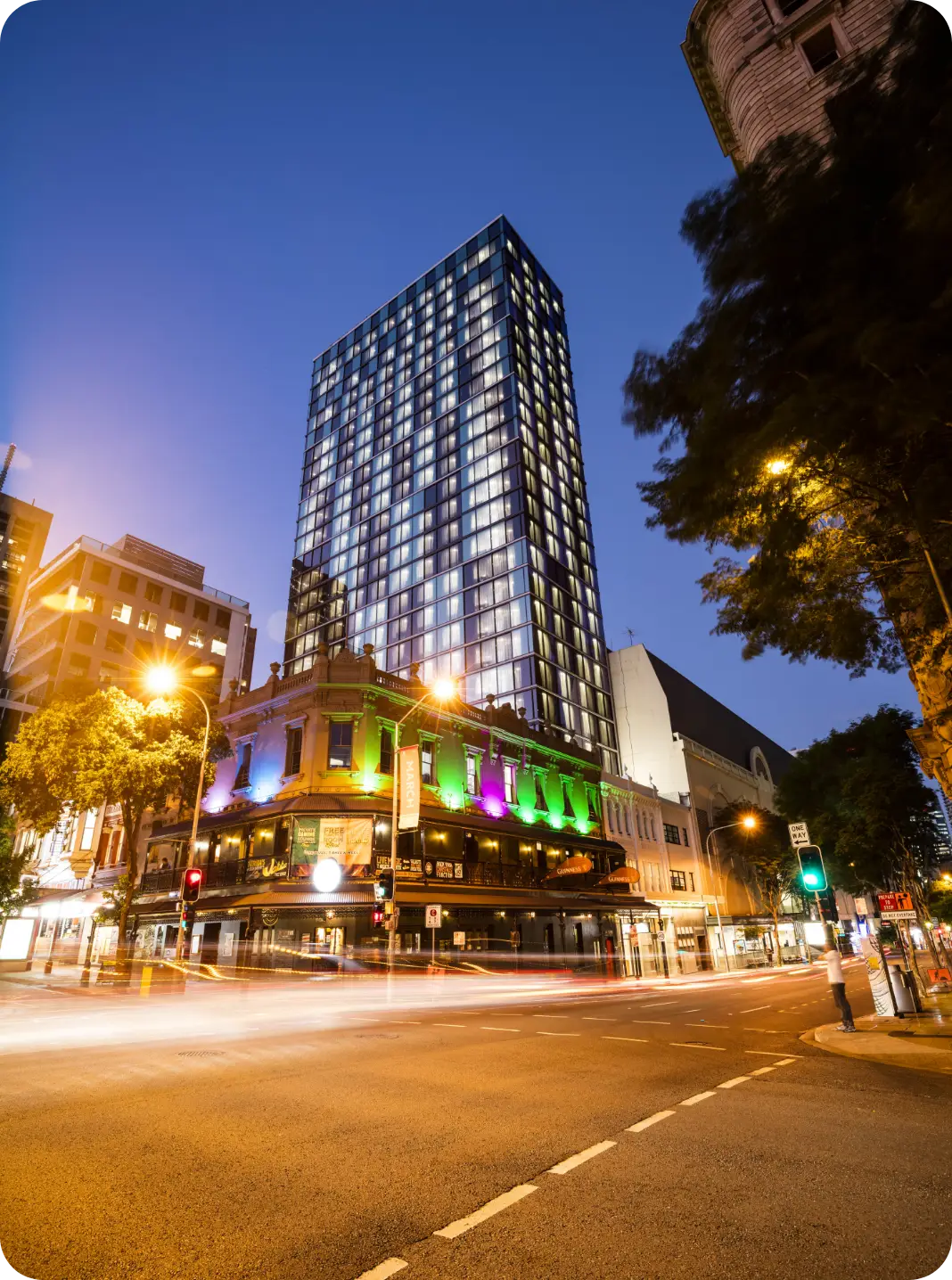
Transforming ibis Styles Brisbane Elizabeth Street
BREAKING RECORDS
In Brisbane
+$2,859,069
Achieved in 4-years.
“The strategy HyperHotels delivered for Darwin Airport Resorts was a game-changer. It brought our three properties under one unified vision and provided the clarity our board needed to confidently shape the future direction of our hotels.”

CHRIS CHAFFE
General Manager
Darwin Airport Resorts
General Manager
Darwin Airport Resorts