
Building direct demand from a standing start.
Investment, discovery and early results
Helium live 1 March 2026 on a new website; AI Source Starter added 1 June 2026. In OmniHyper’s experience, search can take 6 to 9 months to show clearly in commercial results. Commercial figures are year on year; search and website figures compare months within 2026.
THE INVESTMENT
7 + 4 months
Helium for seven months and AI Source Starter for four, on standard monthly subscriptions. Google Paid media spend is excluded.
Source: OmniHyper contracts.
WHAT CHANGED IN DISCOVERY
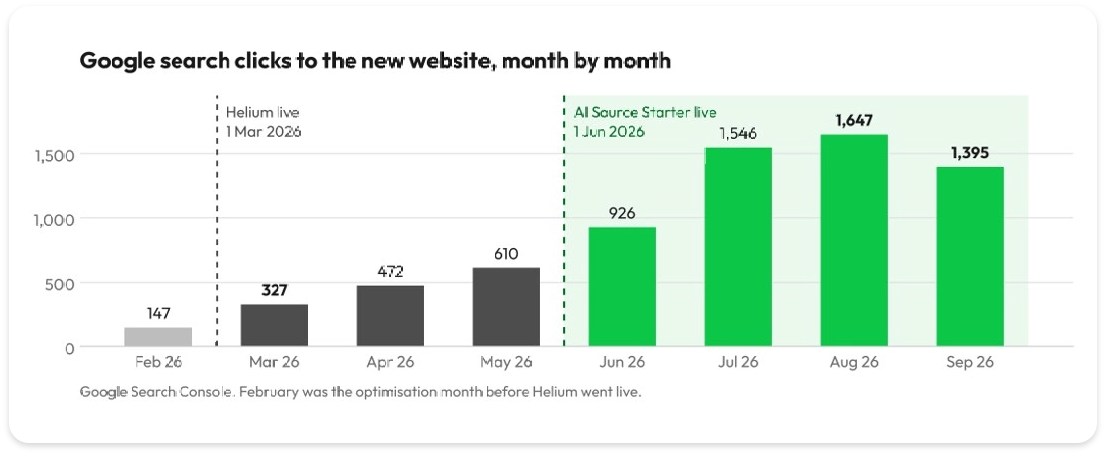
327 to 1,395
Monthly Google search clicks, March to September 2026, peaking at 1,647 in August, on a website with no search history.
Organic search: 10.4% of website sessions, but 42.3% of Book Now clicks and 52.8% of enquiries. “hotel hobart”, around 4,400 searches a month, ranked 2nd at 30 September, up 99 places.
Source: Google Search Console; Rank Tracker via the OmniHyper dashboard; Google Analytics 4.
EARLY COMMERCIAL INDICATORS
+7.7%
MICE and wedding revenue, March to September, year on year, on converted bookings up 10.2%.
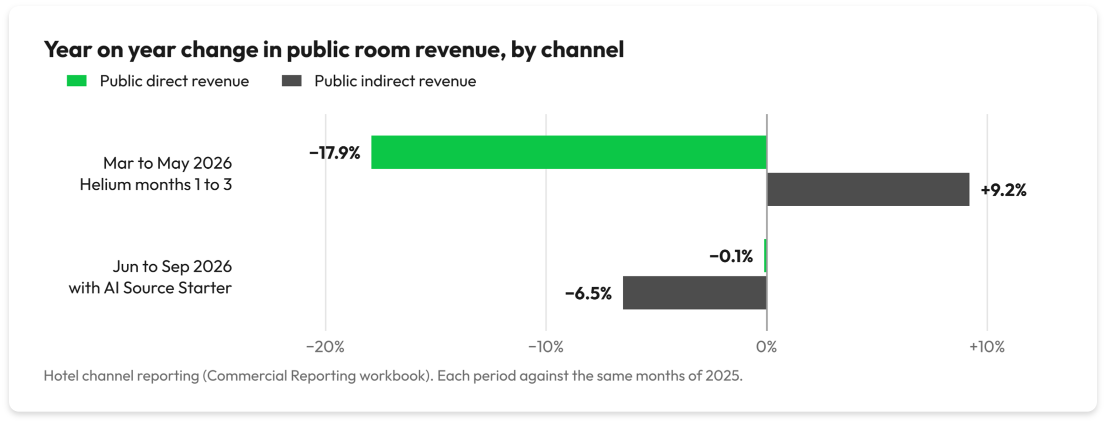
−17.9% to −0.1%
Direct room revenue year on year, March to May against June to September, while indirect revenue fell 6.5% from June.
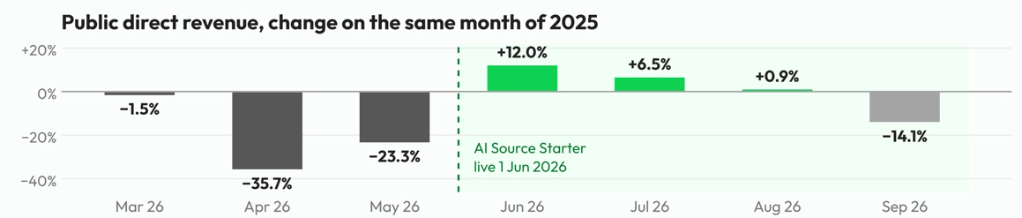
Across March to September, public direct room revenue fell 8.7% year on year. From June to September it held broadly level, down 0.1%, while June to August recorded 6.5% growth.
Source: The hotel’s own channel reporting (Commercial Reporting workbook).
Please note: these outcomes cannot be attributed solely to Helium or AI Source. Google Paid, hotel and brand marketing and wider trading conditions also influenced performance; occupancy fell from 81% to 74% across the period.
Full source : Building Direct Demand From a Standing Start – Hobart CBD Hotel. Every claim sourced, with a claim-to-source map.
Hobart CBD Hotel
Activation: 1 March 2026, Helium organic search on a new microsite launched in January 2026, with AI Source Starter added on 1 June 2026
Scope: Organic search and AI search: Helium and AI Source Starter, with Google Paid in support
Measurement Period: 1 March 2026 to 30 September 2026, month 7 of Helium and month 4 of AI Source1
Hotel Context & Market Changes
The hotel is a full-service, branded property in Hobart, Australia, with conference, event and wedding facilities and a distinctive premium guest offer.9 In January 2026 the hotel launched its own property website for the first time, separate from its brand’s central website. Google recorded its first search impressions in late January 2026, and 147 clicks across February, the site’s first full month.7 OmniHyper completed the initial optimisation and alignment of the new site in February, and the Helium organic search programme went live on 1 March 2026, with Google Paid running alongside to put early wins on the board while organic search matured. AI Source Starter was added on 1 June 2026.2
Demand for Hobart was not the constraint. Google Trends indexed interest for “hotel hobart” averaged 82 from March to September 2026, against 69 for the same months of 2025, and “accommodation hobart” averaged 71 against 67.3 Horwath HTL, using STR data, records Hobart RevPAR up 6.5% for the year to June 2026, with hotel supply forecast to grow 2.1% a year to 2030.4 Tourism Tasmania reports commercial occupancy in Southern Tasmania of 70% for the June to August quarter, up 1.9 points, and 67.5% in August, the region’s highest August in seven years.5
The hotel’s own trading did not keep pace with that market. Across March to September, average occupancy was 74% against 81% a year earlier, with average daily rate up 3.5%. Public direct room revenue fell 8.7% and direct room nights fell 11.0%, while indirect revenue held level, up 0.6%. The comparison year was unusually strong: against March to September 2024, 2025 direct revenue was 15.3% higher and direct room nights 20.4% higher, and 2026 direct revenue remains 5.2% above 2024.6 More travellers were searching for a Hobart hotel and the market was growing, yet a larger share of this hotel’s business was being booked through third parties.
The question for the programme was therefore not whether demand existed. It was whether a website with no history could become the place where travellers, event planners and AI systems found the hotel and chose to book it direct, and how quickly that could happen.
The Challenge
The property came into the period with four connected problems, all of them about being found and credited rather than about demand.
- A brand new website with nothing to inherit. The microsite launched in January 2026 with no search history, no rankings and no authority, and earned 147 search clicks in February.7 Organic search typically takes six to nine months to show in commercial results, closer to nine on a new domain, which the hotel accepted from the outset. Google Paid was added for that reason, to deliver early wins while organic search matured.2
- Revenue was moving toward third parties. In the first three months, while organic search was still establishing, public direct revenue fell 17.9% year on year, while indirect revenue rose 9.2%. Direct’s share of public room revenue fell from 63.1% to 56.3%.6
- AI systems described the hotel using other people’s content. The new site declared nothing about itself in machine-readable form: no address, telephone number, star rating or amenity list. In July it supplied 2.2% of AI citations about the property, behind Google, both TripAdvisor domains, a competitor’s website and a hotel group the property does not belong to. All four AI platforms named parking and breakfast costs as its main weakness, although three published packages include both.9
- Searches for the hotel were being answered without a click. On 24 branded searches matched exactly between August and September, the property ranked 0.33 of a place better and was clicked 25.5% less, the pattern expected when an AI answer appears above the result.9
There was also a measurement problem underneath the commercial one. Every booking completes on the brand’s central booking engine, so the microsite cannot record a reservation or its value: Google Analytics recorded no key events and no revenue across the period.8 The brand’s own reporting credits the website only when it is the last click before booking. Google Ads conversion data also stopped passing through from about 2 August 2026, after tags were removed from the website, so paid search could not be judged on outcomes either.13
The objective was therefore to make the hotel the one that travellers, planners and AI systems find for the questions Hobart visitors actually ask, and to turn that visibility into direct business through the hotel’s own channels, measured wherever possible in the hotel’s own figures.
Approach
Helium was the foundation, AI Source Starter was layered over it from 1 June, and Google Paid ran in support. Each was scoped to the stage of a brand new website.2
- Launch optimisation, February 2026. Keyword research, initial optimisation of the new microsite for target keywords and Google best practice, alignment with Google and submission to the major search engines and directories, provided as part of the 12 month Helium subscription.2
- Helium organic search, from 1 March. Ongoing technical, content and authority work across international, national, state and city markets, tracked against 19 priority keywords ranging from brand terms to “hotel hobart”, “accommodation hobart” and “hobart waterfront hotel”, with a monthly dashboard drawing on Google Search Console, Google Analytics and rank tracking.10,14
- AI Source Starter, from 1 June. The entry tier of AI Source: an AI readiness audit, semantic and entity analysis, structured data planning and foundational optimisation for Google AI Overviews and AI Mode, ChatGPT, Gemini and Perplexity across core guest journeys. Starter is designed to establish an initial presence before scaling.2,14
- Answer level findings, reported monthly. Mae, OmniHyper’s AI digital marketing agent, reported each month on share of voice, sentiment, position and citations across four platforms and set out owned actions: the hotel’s signature guest amenity as a unique, quotable claim; parking and breakfast packages the AI answers did not know existed; searches for a former in-house restaurant that closed several years ago still landing on a conference page; and function packages published only as a brochure download, with no rates on the page.9
- Google Paid in support, from 1 March. Campaigns ran across search, display and YouTube. Paid is reported for completeness and is not the subject of this study.11
- Measurement repair. In September OmniHyper issued a specification for conversion actions on the brand booking hand-off, the enquiry form and the telephone and email links, for implementation with the website platform provider.13
What is live and what is pending. Alongside the AI readiness audit, OmniHyper carried out on-page optimisation of the website under both Helium and AI Source, and delivered the monthly reporting across four platforms and the measurement specification.14 The single largest recommended change, publishing the hotel’s machine-readable record (address, telephone, rating, amenities and check-in times), was specified in July and is awaiting the hotel’s sign-off; FAQ markup and the signature amenity and function package page changes are scheduled for October and November. The AI results in this study therefore reflect the website before those changes.9
Observable Changes
1 March to 30 September 2026. The website did not exist in 2025, so search and website measures are read month on month.
- Search clicks grew more than four-fold. Google search clicks rose from 327 in March to 1,395 in September, 4.3 times the first month of Helium, peaking at 1,647 in August after rising every month. Impressions grew from 10,445 to 43,101 over the same months, with 6,923 clicks from 176,725 impressions across the period, and click through rate rose every month from March to August, from 3.13% to 4.78%. Since AI Source went live, clicks have averaged 1,379 a month against 470 from March to May.7
- September’s dip came with better rankings, not worse. Clicks fell 15.3% to 1,395, the first decline. 42.1% of the fall came from searches for the hotel by name, where it ranked better and was clicked less, a pattern consistent with AI answers resolving more branded searches on the results page.9
- Competitive rankings were won from nothing. 12 of 19 tracked keywords ranked at the end of September, a net gain of 243 positions. “hotel hobart”, with around 4,400 searches a month, ranked 2nd, up 99 places, and “hobart waterfront hotel” 8th, up 15.10
- Organic search delivers the site’s highest intent visitors. Organic search brought 10.4% of website sessions but 42.3% of Book Now clicks through to the brand’s booking engine (747 of 1,765) and 52.8% of enquiry form submissions (94 of 178). It produced 78.7 Book Now clicks per 1,000 sessions against 11.5 for paid search, nearly seven times as many, at 54.8% engagement against 23.7% site wide.8
- AI assistants became a measurable channel. Google Analytics recorded its first AI Assistant sessions in June, then 6, 21, 29 and 25 sessions from June to September. In September they engaged at 52.0%, the highest rate of any channel, against a site average of 30.9%. The numbers are small and reported as a direction.9
- AI systems speak well of the hotel. Across ChatGPT, Gemini, Perplexity and Google AI Mode, favourable sentiment ranged from 93% to 97% in August, and no platform recorded an unfavourable band in July, August or September. On ChatGPT, the hotel’s own website rose from the sixth to the fourth most cited source about it between August and September.9
Commercial Indicators
Commercial outcomes are taken from the hotel’s own channel reporting, completed by the hotel independently of OmniHyper and of Google Analytics. Each period is compared with the same months of 2025.6
- The direct channel stabilised from June. From March to May public direct revenue fell 17.9% while indirect rose 9.2%. From June to September, the four months after AI Source joined Helium, direct revenue held level, down 0.1%, while indirect fell 6.5%. Direct went from trailing indirect by 27.1 points to leading it by 6.4.6
- Meetings, events and weddings grew. MICE and wedding revenue rose 7.7% across the period, on converted bookings up 10.2%. From June to September converted bookings rose 19.7%, and August revenue more than doubled year on year. On the website, organic search produced 52.8% of enquiry form submissions; those enquiries are not all MICE or weddings, and the source of each converted booking is not tracked.6,8
- June to August grew. Public direct revenue rose 6.5% and direct room nights rose 0.5%, while total room nights fell 4.7%. By month, direct revenue moved from 35.7% down in April and 23.3% down in May to 12.0% up in June, 6.5% up in July and 0.9% up in August, before a 14.1% fall in September, when occupancy was 77% against 82%.6
- More of the hotel’s public revenue came direct. Direct’s share of public room revenue rose every month from 57.8% in June to 65.5% in September. Across June to August it was 61.0% against 57.4% a year earlier, after falling to 56.3% from 63.1% in March to May.6
- Rate held. Average daily rate across the period rose 3.5% year on year, and the direct rate for June to September rose 2.0%.6
- The last click records only part of the journey. The brand’s reporting credits the website with direct bookings from March to September, from a standing start, with monthly credited revenue rising more than three-fold from March to August. That is 2.4% of the hotel’s public direct revenue, in a period when the website sent 1,765 Book Now clicks to the brand’s booking engine. A guest who finds the hotel in search or an AI answer and books later on the brand website or app is not credited to the website. This is revenue credited under the brand’s last click reporting; any earlier influence is unmeasured.12,8
Interpretation
In seven months, a website with no search history became a measurable direct channel for the hotel: more than four times the search clicks of its first month, rankings on Hobart’s most competitive accommodation searches, and the highest intent visitors on the site. In the four months after AI Source Starter joined Helium, the hotel’s direct channel moved from a 17.9% decline to level year on year while indirect revenue fell, and meetings, events and weddings grew. The improvement cannot be separated between AI Source, a maturing Helium programme, other marketing and trading conditions. The evidence is consistent with the programme contributing to that recovery, and this case study does not claim more than that.
It is also early. Helium is in month seven of a twelve month programme on a domain that launched in January, inside the six to nine months in which organic search usually begins to show commercially. AI Source Starter is in month four, at the entry tier, and its largest recommended changes, including the hotel record that would let AI systems quote the hotel’s own website, are not yet live.9
What is not claimed. Occupancy fell from 81% to 74% in a growing Hobart market. That is a whole of hotel result driven by more than search, and this study does not attempt to explain it. September direct revenue fell 14.1%. Google Paid, the hotel’s own paid social and email campaigns and the brand’s own marketing all ran in the same period. In AI answers, the hotel slipped from first to second on the question about its signature amenity across all four platforms in September, a content gap now scheduled for correction.6,9
The evidence chain
- A new website launched in January 2026 with no search history, while direct revenue was falling and indirect revenue rising.6,7
- Helium went live on 1 March 2026 and AI Source Starter joined it on 1 June 2026.2
- Search clicks rose 4.3 times from March to September, peaking in August, and “hotel hobart” reached 2nd in Google.7,10
- Organic visitors produced 42.3% of Book Now clicks and 52.8% of enquiries from 10.4% of sessions.8
- The brand’s last click reporting credited the website with 2.4% of public direct revenue.12
- Direct revenue moved from 17.9% down in March to May to level in June to September, while indirect revenue fell 6.5%.6
Together, these signals are consistent with a direct channel being rebuilt through search and AI discovery, with potential influence beyond the last tracked click. A guest who meets the hotel in an AI answer or a search result, then books on the brand website, in the brand app or by phone, is credited to the brand rather than to the website, even though the website may have started the booking.
Most of the evidence comes from systems OmniHyper does not control: Google Search Console, Google Analytics 4, Google Trends, the hotel’s own channel reporting, the brand’s website attribution and published market reports. Taken together, they show a new website establishing search visibility at speed, engaged high intent traffic, and a direct channel that stabilised once AI Source joined Helium. That is credible early evidence, not proof of incremental revenue, and it gives the hotel a data based starting point for the budget review it planned once results were available.
Appendix: Claim-to-Source Map
This case study was designed to minimise reliance on agency reported metrics. Wherever possible, outcomes are drawn from systems owned by Google, the hotel’s brand or the hotel itself, so that every claim can be verified independently.
| # | Claim | Source | Window | Brand Access |
|---|---|---|---|---|
| 1. | Demand growing: “hotel hobart” interest 69 to 82; Hobart RevPAR +6.5% YTD June 2026; Southern Tasmania occupancy 67.5% in August, a seven year high | Google Trends; Horwath HTL / STR; Tourism Tasmania / STR | Mar to Sep 2026 vs 2025 | Public |
| 2. | Hotel trading: occupancy 81% to 74%; ADR +3.5%; public direct revenue -8.7%; indirect +0.6% | Hotel internal channel reporting (Commercial Reporting workbook) | Mar to Sep 2026 vs 2025 | Hotel / brand internal |
| 3. | New website: first search impressions late January 2026; 147 clicks in February | Google Search Console | Jan to Feb 2026 | Direct (Google property) |
| 4. | Clicks 327 to 1,395 March to September (4.3 times), peak 1,647 in August; impressions 10,445 to 43,101; 6,923 clicks from 176,725 impressions; 1,379 a month from June vs 470 | Google Search Console | 1 Mar to 30 Sep 2026 | Direct (Google property) |
| 5. | September clicks -15.3%; 42.1% of the fall from branded searches ranked 0.33 better and clicked 25.5% less | Google Search Console, analysed in the AI Source report (Mae) | Sep vs Aug 2026 | Direct (Google property) |
| 6. | 12 of 19 keywords ranking; net +243 positions; “hotel hobart” 2nd (+99) | Rank Tracker via OmniHyper dashboard | 1 Mar to 30 Sep 2026 | Via dashboard |
| 7. | Organic search 10.4% of sessions, 42.3% of Book Now clicks (747 of 1,765), 52.8% of form submissions (94 of 178); 78.7 vs 11.5 Book Now clicks per 1,000 sessions | Google Analytics 4, channel and event exports | 1 Mar to 30 Sep 2026 | Direct (GA4 property) |
| 8. | AI Assistant sessions 6, 21, 29, 25; 52.0% engagement in September; sentiment 93% to 97%; no unfavourable band July to September; ChatGPT own-site citation rank 6th to 4th | GA4 and AI Source brand analyses (Mae): ChatGPT, Gemini, Perplexity, Google AI Mode | Jun to Sep 2026 | GA4 direct, reported by OmniHyper |
| 9. | Direct -17.9% vs indirect +9.2% (Mar to May); direct -0.1% vs indirect -6.5% (Jun to Sep) | Hotel internal channel reporting | Mar to Sep 2026 vs 2025 | Hotel / brand internal |
| 10. | June to August direct revenue +6.5%; direct room nights +0.5%; direct share 61.0% vs 57.4%; monthly share 57.8% to 65.5% | Hotel internal channel reporting | Jun to Sep 2026 vs 2025 | Hotel / brand internal |
| 11. | MICE and wedding revenue +7.7%; converted bookings +10.2%; June to September bookings +19.7% | Hotel internal channel reporting | Mar to Sep 2026 vs 2025 | Hotel / brand internal |
| 12. | Website credited with 2.4% of public direct revenue (last click), against 1,765 Book Now clicks | Brand reporting via hotel workbook; Google Analytics 4 | 1 Mar to 30 Sep 2026 | Brand internal; GA4 direct |
| 13. | Google Paid in support; conversion data interrupted from about 2 August 2026 | Google Ads via OmniHyper dashboard; OmniHyper correspondence | 1 Mar to 30 Sep 2026 | Google Ads account |
Every source above is either publicly reproducible or accessible to the hotel and its brand without reliance on OmniHyper, with the exception of the Rank Tracker and the AI platform brand analyses, which are produced inside the Helium and AI Source programmes. Search and analytics figures can be verified in the property’s own Google Search Console and Google Analytics 4; commercial figures can be verified in the hotel’s own revenue reporting.