
Transforming Fairmont Resort Blue Mountains
“Mind-Blowing”: What an AI Search & Commercial Opportunity Analysis Shows Your Hotel
Michael MacDonald
Director at OmniHyper
Nov 3, 2026
10 MIN READ
"Mind-Blowing": What an AI Search & Commercial Opportunity Analysis Shows Your Hotel
“This is mind-blowing.”
That was the reaction of the CEO of a UK hotel owner group last week, about halfway through a walkthrough of AI Search & Commercial Opportunity Analyses for three of his hotels. A day later, a general manager in Western Sydney learned that the website his head office wanted him to close was the reason AI recommends his hotel at all.
Neither meeting was a sales pitch. Both were simply a hotel seeing, for the first time, how AI actually sees it. This piece explains what the analysis is, what it showed those two hotels, and why every GM, Director of Sales and Marketing, Commercial Director and head office team should have one in front of them before the next budget conversation.
What the Analysis Actually Looks At
We ask AI the questions your guests ask, and record what comes back. Each analysis runs 30 guest-style questions across the six conversations that matter most to your hotel. Each question is asked in both ChatGPT and Google AI Mode, giving 60 real AI answers. Some questions name your area. Others are broader, the way a guest would ask before they know where they want to stay.
From those answers, plus 12 months of Google search demand and three numbers you give us (occupancy, ADR and average length of stay), the analysis answers five commercial questions:
1. How visible are you? The share of AI answers that put your hotel in the top three, split by platform and by conversation.
2. Who controls the narrative? When AI recommends you, which website it cites: your own site, brand.com, an OTA, a review site or someone else. Every citation is a door to a booking, and it matters whose door it is.
3. How do you compare? The same questions and answers for your competitors, including the ones AI considers your competitors, which are not always the ones on your STR report.
4. Where are the biggest opportunities? Real monthly search demand for each conversation, set against how often you are the answer today.
5. What is it worth? A directional estimate of direct room revenue upside, built from your own ADR and length of stay, with every assumption shown.
Hotels that target meetings and events, or weddings, also get a dedicated view of each, including how many enquiries a month they could be driving. Every question we ran and every answer we recorded is in the appendix, so nothing is a black box. Your team can rerun any of them tomorrow.
Three Hotels, Three Very Different Stories
A UK owner group put three of its hotels through the analysis: an airport and exhibition hotel, a city-centre hotel in Germany, and a motorway hotel. Same brand, same owner, very different results. One was in AI’s top three in fewer than one in five answers. Another looked strong on ChatGPT, named in 23 of 30 answers, but appeared in only 6 of 30 Google AI Mode answers, where most people still search. And one of the hotels AI rated highest was a competitor the team had never benchmarked against.
The hotel in Germany was the moment the room changed. Around 140,000 searches a month relate to central city breaks in its city, yet the hotel made AI’s top three in fewer than a quarter of answers. It does very well over the Christmas markets, but that business comes through OTAs. In AI answers about the Christmas markets, it did not appear once.
Run against the hotel’s own occupancy, ADR and length of stay, the direct revenue opportunity was so large the model capped it at a quarter of current room revenue, the most we show for any hotel. That is when the CEO said: “This is mind-blowing. We’re the perfect hotel for it. Where there’s a gap in how we’re scoring, it’s massive.”
The group left the meeting planning a strategy paper on what they will do themselves, what they will push their brand to do, and which hotels to test first. Their Marketing Manager summed it up in four words: “We need to get cracking.”
The Website Head Office Wanted Closed
The Western Sydney hotel had a different story, and arguably a more important one. It was in AI’s top three in 45% of answers, level for first place against its competitors. The question was why.
The answer was in the citations. When AI recommended the hotel, 60% of the sources it cited were the hotel’s own website, a microsite the marketing manager has been building and optimising herself. The brand website accounted for 0%. Not a small share. None.
That landed hard, because the brand’s head office has been encouraging hotels to shut their microsites down. On this evidence, closing it would not simplify anything. It would make the hotel close to invisible in AI search overnight, and hand its recommendations to whichever OTA or directory AI found next.
This is not an argument against brand.com. The microsite still sends guests to the brand booking engine to convert. It simply does a job brand.com cannot: it tells AI, in detail and with authority, why this hotel is the right answer for sporting teams, club visitors and business travellers in Western Sydney. Compare that with the UK hotels, which had no website of their own. Their brand pages carried most of their citations, but the team told us local content they upload is often rejected, and a brand page cannot hold a proper guide to a local exhibition centre or the Christmas markets.
The analysis also showed where the Western Sydney hotel still loses. It fades on broader “Western Sydney” and Penrith questions, and appears in only 3 of 10 family answers. The marketing manager recognised both straight away, and a family package she was already building now has data behind it.
The prize is significant. Based on the hotel’s own occupancy, ADR and length of stay, winning more of the searches it misses today is worth an estimated 6% to 11% of current room revenue in direct bookings, from a hotel that is already ahead of its competitors.
What You Can Do With It, With or Without Us
Every analysis ends with three priority actions specific to the hotel. Most of them a hotel team can start on this week, without an agency. From these two meetings alone:
- Answer the practical questions guests actually ask. Parking, breakfast hours, late arrivals, shuttle buses, twin rooms, connecting rooms. The UK team realised their event shuttle bus, a few minutes to the exhibition centre door, may not be anywhere AI can find it.
- Build pages for the demand you can see. Local stay guides for the exhibition centre, the airport, the Christmas markets or a new airport opening nearby. If thousands of people a month are asking and you have nothing to point AI to, someone else gets cited.
- Keep, and strengthen, your own website. If your microsite is earning the citations, it is an asset, not a duplicate. Make sure its content is structured so machines can read it, not just people.
- Fuel the spark first. As the UK CEO put it, where a hotel is already named in 3 of 5 answers on one platform and 0 of 5 on the other, there is something to build on. That is often a better first bet than the conversation where you are absent for good reason.
- Measure the same questions again. Because every question is listed, the analysis becomes your baseline. Rerun it in three months and you will know whether visibility, and citations, are moving.
At group and head office level, it gives something just as valuable: evidence. Which hotels to pilot, where budget should go, and whether a policy like closing microsites would help or hurt, can all be decided on data rather than opinion.
Request Your Analysis
The AI Search & Commercial Opportunity Analysis is complimentary, and open to any hotel: any flag, any size, branded or independent. All we need is your occupancy, ADR and average length of stay, the competitors you watch, and whether you sell meetings, events or weddings.
We reply within two business days, and walk you through your analysis five business days after you book. You keep the full report, every question and every answer, whatever you decide to do next.
Guests are already asking AI where to stay. The only question is whether your hotel is the answer, and whose website gets the booking.

Michael MacDonald
Director
With 25+ years in hotel digital marketing, Michael has driven success for Accor, IHG, and Marriott worldwide.
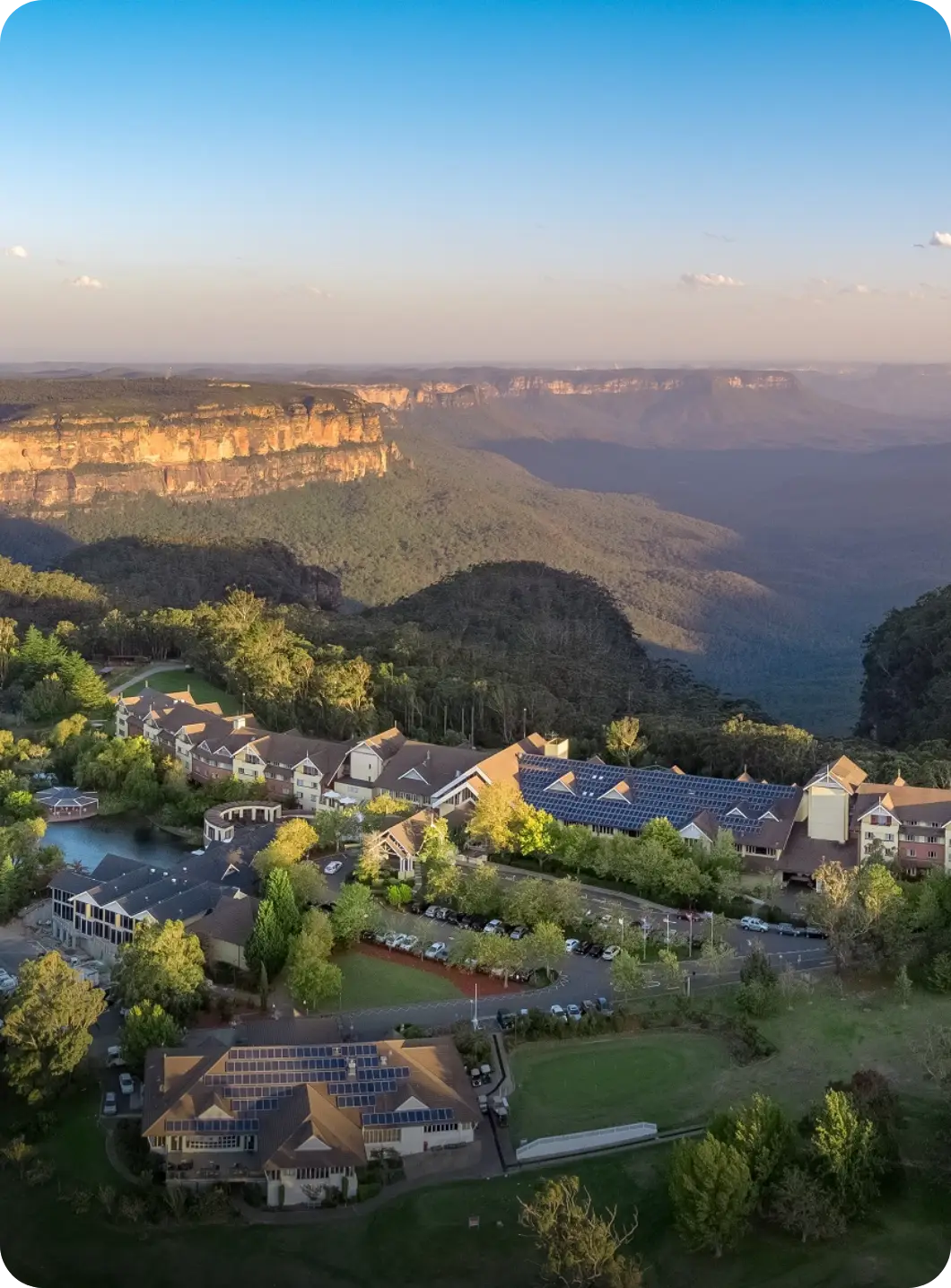
Transforming Fairmont Resort Blue Mountains
QUICK WINS IN THE
BLUE
MOUNTAINS.
+$237,561
Achieved in the first 90-days.
“We’ve seen a significant increase in RFP enquiries, occupancy rates, and ancillary revenue through food and beverage. The tailored approach has delivered impressive results that exceed our expectations. I highly recommend their services to any hotel or convention centre looking to elevate their MICE offerings.”

TRICIA CORNELIUS
Regional Director of Sales & Marketing
Queensland & Northern Territory Accor