
Transforming Sofitel Brisbane Central
More Than Search: The DICE Strategy Behind Every Hotel We Work With
Michael MacDonald
Director at OmniHyper
Nov 10, 2026
12 MIN READ
More Than Search: The DICE Strategy Behind Every Hotel We Work With
People often assume OmniHyper is an SEO agency. Lately, they ask whether we do “AEO” or “GEO”. What we actually do is help hotels grow direct bookings and direct revenue.
Search is one of the ways we do it. The job itself is winning the acquisition battle: getting more of the same demand to arrive through the channel with the lowest acquisition cost, and proving it in the hotel’s own revenue numbers. Every booking that arrives through an OTA carries a commission that never comes back. Every booking that arrives through organic search, a map listing or an AI assistant that names the hotel and cites its own website costs a fraction of that.
Doing that well needs a strategy above the tactics. Ours is called DICE. Every programme we run, every opportunity analysis we present and every recommendation we make sits inside it. This article explains what it is, how it works, and why it is a useful lens for any hotel, whether or not you work with us.
Why Tactics on Their Own Are Not Enough
Here is a real hotel, over a 90 day window. Its traditional organic rankings improved by 57%. Over the same period, organic traffic fell 16.7%, organic direct bookings fell 56% and organic direct revenue fell 48.8%.
Nothing was wrong with the search work. The guest journey had moved, and the strategy had not moved with it. Guests were increasingly asking AI where to stay, strong rankings no longer guaranteed visibility, and the standard reports could not see what was happening.
Rankings measure one stage of one channel. Revenue comes from the whole journey. That is the gap DICE is designed to close.
What DICE Is
DICE maps the guest journey across four stages: Discover, Interact, Convert and Engage. It sets those stages against the four types of media that operate within them: paid, owned, earned and the newest, AI and generative media.
A guest moves through the stages over time. At each one, different things decide whether they keep moving towards a direct booking or drift off to an OTA. The value of the framework is that it makes you look at every stage, not just the one you happen to be measuring.
Discover: The Guest Has Not Chosen Yet
They search, ask an assistant, read an AI summary or scan a map. This is where organic and local search, AI Overviews, the sources that AI platforms cite, paid search, social and content all compete for attention.
Discover has changed more in the last two years than in the previous ten. Searches have gone from three or four keywords to conversations of 20 to 25 words, full of personal preferences. Instead of a page of links, the guest gets an answer. And being the answer is not enough. If AI recommends your hotel but cites an OTA as its source, the OTA may still take the booking.
The question to ask:
When a guest asks AI for a hotel like ours in our city, are we named, and is our own website the source?
Interact: The Guest Is Considering You
They land on a page, read reviews and compare before they ever see a rate. Your home page, room and facility pages, landing pages that answer the questions guests actually ask, and the density and quality of your reviews all do the work here.
Your website is a claim. A review is evidence. Guests weigh them differently, and so do AI platforms. The best page about your neighbourhood today was often written by an OTA that has never been there.
The question to ask:
Does our website answer the specific questions guests ask (parking, who sleeps where, walking times to the venues they name), or does an OTA answer them better?
Convert: Interest Becomes a Reservation
Rate, availability, merchandising and the booking engine turn interest into a booking, supported by remarketing, personalisation and increasingly an AI assisted buying journey. Google has already begun testing hotel bookings completed inside the AI answer itself, from live rates and availability.
This is where strong visibility can be quietly undone. If an OTA is showing a cheaper rate, the best search work in the world may not turn into a direct booking.
The question to ask:
When we win a guest’s attention, is our direct path the most competitive one in front of them?
Engage: The Guest Comes Back, and Brings Others
Onboarding, loyalty, re-engagement email, personalisation and the stay itself bring a past guest back again and again. Most hotels think of this as the end of the journey. It is not.
The Loop Most Hotels Miss
What guests say after their stay now shapes how AI describes your hotel to the next guest. Reviews, your replies to them and guest content are third party evidence written in guest language, and AI platforms read them at the Discover stage.
We call this the brand signal loop. It means Engage feeds straight back into Discover, and DICE is a loop rather than a funnel. A great stay and a well handled review are no longer only an operations matter. They are a search asset. The reverse is also true. After a rebrand, an old name or outdated facility can linger in AI answers for years if the information about the hotel is inconsistent across the web.
Where We Sit, and Where We Do Not
We say this plainly, because it matters to how a hotel should judge any search partner. Discovery is ours. Conversion is not.
Our work is concentrated in Discover, and in the parts of Interact that decide whether the right guest lands on the right page and finds the answers they need. Rate, availability, the booking engine, loyalty and the stay itself belong to the hotel and, for branded hotels, the brand. We complement the brand. We do not compete with it.
Within Discover, guests behave in three different ways, and each needs different work:
- Zone, local search: winning the guest who is already nearby, in maps and the local pack.
- Helium, traditional search: winning the guest who is searching and planning, in the organic results.
- AI Source, AI search: winning the guest who is asking AI where to stay, so the hotel is both the answer and the source it cites.
Same commercial objective, different guest behaviour, different work and different measurement. Not every hotel needs all three. A suburban hotel with strong local demand needs local search far more than anything else, while a hotel fighting for share in a competitive CBD may need all of them. That decision comes out of a discovery conversation about what the hotel is trying to fix, not out of a product list. Sometimes the honest answer is to do nothing, because the opportunity is not big enough to justify the spend.
Our test for every recommendation is simple. It has to be a win for the owner, a win for the brand and a win for us. If any one of the three is not winning, the model does not work.
Why the Whole Journey Matters: A Story About a Pool
One of the hotels we work with, in a popular tourist destination, was performing very well in AI search. It was the answer and the source of truth, and the right guests were reaching its website. But they were not booking.
Mae, our AI strategist, worked out why. Guests searching in that market wanted a hotel with a pool, and every competitor in the area had one. This hotel did not.
No amount of SEO would have fixed that. So the general manager created a package that included a day pass to a local hot pool. Conversion improved straight away, and on the strength of that result the owner is now building a pool and spa.
That problem only showed up because we were looking at the whole journey. Measured on Discover alone, the programme looked like a success. Measured on DICE, there was a gap at Convert, and closing it was worth far more than another ranking.
How We Measure It
A strategy is only as good as the evidence that it works. Traditional reporting was not designed for AI assisted guest journeys: attribution is last click, and much of what AI sends a hotel lands in Direct, looking like a guest who already knew you.
So we do not rely on one metric from one tool. We build a chain of independent evidence: the hotel’s context and market conditions, observable changes in discovery from Google Search Console, Google Analytics and AI visibility tracking, and commercial outcomes from the hotel’s own revenue reporting, independent of us. We are also clear about what we cannot claim. Search is one contributor to direct revenue among several, and we show our working.
We have written about this in more detail in How to Prove AI Search Actually Works for Your Hotel.
Five Questions to Ask Your Team
You do not need an agency to start using DICE. Take these to your next commercial meeting:
- Discover: when guests ask AI or Google for a hotel like ours, are we the answer, and are we the source of truth, or do OTAs control the narrative?
- Interact: when a guest lands on our website, does it answer their real questions better than any OTA page?
- Convert: is our direct rate and booking path the most competitive option the guest can see?
- Engage: are we giving past guests a reason to come back and book direct?
- The loop: are we treating reviews and our replies to them as part of our search strategy?
If the answer to any of these is “we don’t know”, that is where the opportunity is.
More Than Search
SEO, local search and AI search are the tools we use, and we are specialists in all three. But we are not selling search. We are helping hotels win the acquisition battle and grow profitable direct revenue, one stage of the guest journey at a time.
If you would like to see where your hotel stands across DICE, book a free hotel growth consultation with our team.

Michael MacDonald
Director
With 25+ years in hotel digital marketing, Michael has driven success for Accor, IHG, and Marriott worldwide.
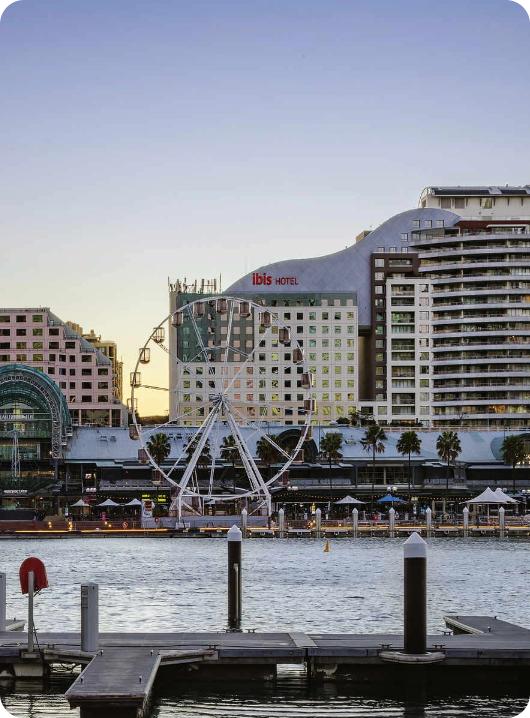
Transforming ibis Sydney Darling Harbour
PROFITS
ANCHORED
IN GROWTH
+$2,506,999
Additional revenue achieved in 3-years.
“We’ve seen a significant increase in RFP enquiries, occupancy rates, and ancillary revenue through food and beverage. The tailored approach has delivered impressive results that exceed our expectations. I highly recommend their services to any hotel or convention centre looking to elevate their MICE offerings.”

TRICIA CORNELIUS
Regional Director of Sales & Marketing
Queensland & Northern Territory Accor