
Prudence Marzinotto
What Happens When Hotels Block AI Crawlers?
In the last year, AI Search has shifted from “emerging trend” to “immediate reality.” Travellers are now asking ChatGPT, Google Gemini, Perplexity, and other answer engines where to stay, what to do, and which hotel brands they can trust. Increasingly, they expect instant, confident, summarised answers, not a list of ten blue links to sift through.
Which is why what’s happening right now in the hotel world is so surprising:
some hotels, many of them major global brands, are blocking AI tools from crawling their websites.
This means those brands cannot be surfaced properly in AI-generated responses. They cannot be referenced accurately. They cannot be recommended organically. They risk missing out on the new era of search that is already taking shape.
This is happening publicly, in their robots.txt files, essentially their website’s “allow or deny” list for search engines and crawlers.
The New Search Battlefield: AI Over Answers, Not Listings
For the first time in search history, your website isn’t just competing with other hotels.
It’s competing with an entire system of AI-generated answers that decide whether you appear at all.
Traditional search (SEO) was about ranking.
AI search is about inclusion.
If your brand isn’t in the dataset, if AI cannot crawl your content, you won’t be in the answer.
Here’s what travellers are already doing today:
- “Where’s the best hotel to stay in Brisbane for business travel?”
- “Which Bali resorts have the best family-friendly facilities?”
- “What’s the most affordable luxury hotel near the Melbourne CBD?”
- “Which hotel loyalty program is best for boutique or lifestyle stays?”
In these moments, if an AI system hasn’t been allowed to read your brand site, your hotel does not get mentioned, even if you are the perfect fit for the query.
This creates a significant challenge for visibility, direct bookings, and brand positioning, especially as AI search becomes the default behaviour for Millennials and Gen Z (who already prefer conversational search to conventional browsing).
Blocking AI is like switching off your hotel’s exterior signage and hoping guests still find the front door.
Why Are Hotels Blocking AI?
Most hotels aren’t talking about it, but here are the industry’s best guesses.
1. Legal and IP fears
AI scraping is new. Some legal teams prefer to block everything until told otherwise. The problem? The longer you block, the more invisible you become in AI-driven environments.
2. Misunderstanding of “privacy”
Some brands see AI crawlers as similar to data-harvesting tools and assume blocking is safer.
Reality check:
Google, Bing, and AI tools follow the same robots.txt standards. Blocking one while allowing the others is inconsistent and strategically risky.
3. Corporate is trying to “control the brand story”
Large groups often want centralised control of content. If AI scrapes inconsistent or outdated info across individual property sites, the brand experience becomes unpredictable.
That’s a fair concern, though blocking AI entirely may be more restrictive than necessary.
Hotels Becoming Invisible in the Decision-Making Phase
When AI can’t crawl your website, it can’t:
- Learn your brand story.
- Understand your room types.
- Understand your amenities.
- Pull your location details.
- Compare you accurately to other hotels.
- Answer specific traveller questions.
- Position your value in relation to price.
- Identify who your ideal guest is.
If AI can only “see” your hotel through third-party sources, OTAs, random reviews, or inconsistent listings, then guess who becomes the dominant voice?
Not you.
Not your brand.
Not even your broader brand messaging.
AI search doesn’t care about your marketing preferences. It cares about data clarity and access. If the only clear, structured, consistent data available about your hotel sits on Booking.com, Expedia, or TripAdvisor, that’s the perspective it will base its answers on.
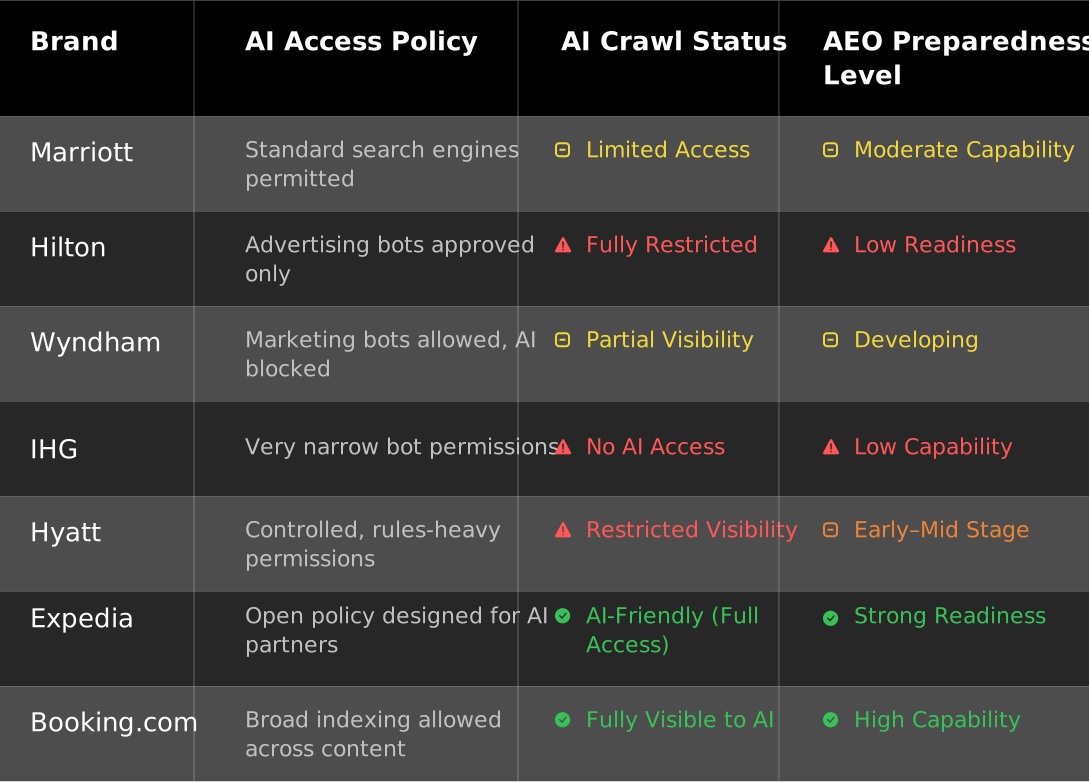
What This Means for Hotel Groups Blocking AI
If you’re a hotel operating under one of these brands, here’s the reality:
Your brand site may be less visible in AI Search, even if your competitors are not.
A smaller, independent hotel, or hotel with a microsite that allows AI crawlers may appear ahead of you, because AI has access to its data.
Your direct channel becomes weaker.
If AI cannot reference you directly, it sends travellers to:
- OTAs.
- Aggregator sites.
- Third-party resources.
All of which dilute your direct revenue.
Your brand story becomes fragmented.
Your brand story becomes fragmented.
Travellers may overlook your hotel.
Not because you’re not a great option but because you weren’t present in the answer.
Will Hotels Adjust Their Approach to AI? Most Likely, Over Time.
Large hotel groups tend to make digital decisions carefully, ensuring they’re protecting brand consistency, guest trust, and long-term strategy. That means any shift in their stance on AI crawling will take time.
Two things are true in the meantime:
- Hotels that revisit their AI permissions earlier may see clearer visibility benefits.
- Smaller or more agile brands or hotels with microsites may be able to experiment faster and learn quicker.
The move toward AI-ready content isn’t about speed, it’s about alignment and accuracy. As AI search becomes a primary way travellers seek information, hotels of every size have an opportunity to participate in shaping how their story is understood.
AI Search Isn’t Waiting for Hospitality to Catch Up
Whether hotels block AI or not, travellers are shifting their behaviour:
- They’re relying on instant answers.
- They’re comparing brands conversationally.
- They’re expecting AI to “just know.”
- They’re booking faster, with fewer touchpoints.
Hotels that overlook this shift risk becoming less discoverable, similar to a restaurant that never quite appears on the map. AI search is the new digital storefront, and visibility within it is non-negotiable.
What Hotels Should Keep in Mind
Hotels that block AI today are often doing so out of caution, not strategy. Caution alone isn’t a growth mindset, and it won’t protect brand visibility in an AI-first world.
As AI search accelerates and travellers grow more comfortable with conversational discovery, hotels that embrace transparency, clarity, and accessibility will win.
Those that maintain restrictive robots.txt files?
They may eventually find themselves less represented in AI-driven conversations.
As a hotelier, that’s not where you want your brand to end up: present online, but missing in the answers that matter.
Is your hotel unknowingly blocking AI and blocking direct bookings with it?
If you’re not sure, we can check. Contact us and we’ll help you improve your visibility in AI Search.

Prudence Marzinotto

Transforming Mercure Gold Coast Resort
Long term growth,
BIG RETURNS
+$2,484,063
Achieved in 6-years.
“Working with HyperHotels for over 10 years has been a game changer for us. Their team truly understands the hospitality industry, and their website solutions have driven significant direct revenue growth. I couldn’t ask for a better partner to help us succeed online.”

DIANE KERINS
General Manager
Millennium Hotel & Resort Manuels Taupo