
AHICE Asia Pacific 2026
What Is an AI Search Opportunity Analysis — and How Can It Help Your Hotel?
Nick Hollows, Partnerships Director, OmniHyper
May 19, 2026
11 MIN READ
What Is an AI Search Opportunity Analysis — and How Can It Help Your Hotel?
There is a conversation happening in boardrooms, ownership groups, and asset management firms right now. It sounds something like this: “What are we doing about AI?”
If you are a General Manager, a Director of Sales and Marketing, or a Commercial Director, you have probably already felt the pressure. The challenge is that most of the answers being offered are vague, theoretical, and impossible to attach to a number that means anything to an owner.
An AI Search Opportunity Analysis changes that. Here is what it is, what it actually does, and why the hotels acting on it now will be the ones setting the pace twelve months from today.
The Problem Worth Understanding First
Traditional hotel marketing has been built on one foundation: search rankings. Get your property to the top of Google, and guests find you. That model worked for twenty years.
It is now breaking.
Travellers are increasingly bypassing traditional search entirely, turning instead to AI platforms — ChatGPT, Google AI Overviews, Perplexity — and asking directly: “What is the best hotel near the city centre with a rooftop bar and lake views?” They receive a synthesised answer. One recommendation. Maybe three. No blue links. No scrolling. No browsing.
The evidence in live market data is stark. Across multiple markets and property types, traditional search volumes for core hotel keywords — “boutique hotel [city],” “hotel near [airport],” “accommodation [destination]” — are declining between 50% and 90% year-on-year. This is not a slow erosion. It is a structural shift.
And here is what makes it genuinely alarming: in the same audits, the properties being studied had zero visibility in AI-generated answers. Competitors were being recommended. They were not. Not because the physical product was inferior — in several cases it was exceptional — but because the AI had no structured, reliable data to work with.
So What Is an AI Search Opportunity Analysis?
An AI Search Opportunity Analysis is a structured audit that examines how AI platforms currently understand, interpret, and recommend your hotel. Think of it as holding up a mirror to your property’s digital identity — not as you see it, but as the machine sees it.
It is built on 12 months of aggregated data, which means it accounts for seasonality and gives you a genuine picture of demand patterns rather than a snapshot. It covers the major AI and search channels: Google AI Overviews, AI Mode, ChatGPT, Perplexity, and others.
The analysis is structured around several key areas.
How AI currently interprets your hotel. This section reveals whether the AI understands your property the way you understand your property. It identifies gaps, misconceptions, and missing data. This matters more than most hotel teams realise: research suggests that approximately 40% of AI-generated answers about specific businesses contain incorrect or misleading information. If the AI believes your restaurant closes at 6pm, or misunderstands your room categories, your potential guests are seeing that.
Your market context. The analysis examines your destination — infrastructure, event calendar, business segments, MICE demand, feeder markets — and asks a pointed question: is your hotel digitally positioned to capture the demand that actually exists in your market?
Your property attributes. This is where physical product gets translated into machine-readable commercial assets. Every facility, programme, and unique attribute needs to be structured in a way that AI engines can retrieve and cite. Without this, those attributes simply do not exist in the AI’s world.
Search volume and year-on-year trends. This section shows the scale of the shift. The keywords your team has been targeting, the ones your SEO strategy has been built around, are migrating to AI platforms at a rate that most hotel professionals have not seen with their own eyes. Across every analysis conducted to date, this section has been the one that stops the room. Teams that have been confident in their digital strategy discover that the landscape they were navigating has fundamentally changed beneath them.
AI Search Visibility. Are you being mentioned when AI gives a recommendation for your category? Or are your competitors being cited while you are invisible? This section provides a precise answer, broken down by query type. A zero score here is not an abstraction — it is a direct measure of bookings going elsewhere. Competitive landscape. How does your AI visibility compare against your five closest peers? Who is being recommended and why?
Commercial opportunity modelling. This is the section that turns the analysis into a business case. Using your actual ADR and average length of stay, the report models the revenue opportunity available if you improve your AI visibility — across conservative, moderate, and optimistic scenarios. It is not a guarantee. It is a data-based projection that shows what is genuinely available.
What Does the Opportunity Actually Look Like?
To give this some grounding, consider three anonymised examples from recent analyses across different markets.
In a lifestyle property in Singapore — 115 rooms, 4-star positioning, competitive inner-city location — the analysis identified a 54% year-on-year decline in traditional search volume across core keywords, and zero presence in AI-generated recommendations. The commercial model, based on the property’s own ADR and booking data, projected an annual revenue opportunity of between SGD $465,000 and SGD $930,000 in direct room revenue alone — before accounting for food and beverage.
In a 4.5-star property in New Zealand — a lakefront hotel in a high-demand leisure destination — the average keyword decline across 29 tracked terms was 46%. Again, zero brand mentions in AI answers. The modelled opportunity: between $6.2 million and $12.5 million in additional annual revenue at different conversion assumptions.
In a Sydney airport hotel — 252 rooms, strong corporate demand, record passenger volumes at the airport — traditional search for core terms was down an average of 48%, with the property having no AI visibility despite holding strong traditional SEO rankings. The modelled opportunity: $466,000 to $932,000 in additional direct revenue annually.
These are not projections built on assumptions about markets that might grow. They are built on real demand that already exists — demand that is currently being answered by someone else.
Why This Matters for Your Ownership Conversation
For a GM or DOSM taking this to an owner, an asset manager, or a head office, the AI Search Opportunity Analysis does something rare: it turns an emerging and sometimes abstract topic into a documented commercial case.
It tells you whether the opportunity is real for your specific property. Not every hotel will have the same exposure — some markets will show steeper shifts than others, some competitive sets will be more advanced — and the analysis will tell you where you actually stand.
It shows you the competitive gap. If your direct competitors are being recommended by AI and you are not, this document shows that gap precisely and quantifies what it is costing you.
It gives you a calculated position to defend. The difference between taking a risk and taking a calculated risk is data. An AI Search Opportunity Analysis provides the data. The investment becomes easier to justify, and the decision to act becomes easier to make.
It also helps you make the case for budget reallocation — not incremental spend, but a redeployment of existing marketing investment toward the channel where guest acquisition is increasingly happening.
The Window Is Open, But Not Indefinitely
The properties that implement AI search optimisation now will establish entity authority — the machine’s understanding of who they are and why they should be recommended — before their competitors do. That advantage compounds over time as AI models continue to learn and reinforce their recommendations.
The properties that wait will find themselves in the position many hotels found themselves in during the early years of OTA dominance: scrambling to recover ground that a first-mover had already claimed.
At every analysis presented to date, the response from hotel leadership has been the same: they had no idea the keywords they were targeting had already migrated this far, and the scale of the visibility gap came as a genuine shock.
The analysis exists to remove that shock — and replace it with a clear, evidence-based direction.
Next Step
If you are a Director of Sales and Marketing, Commercial Director, or General Manager who needs to understand your AI opportunity before your next strategy review or ownership conversation, the starting point is a conversation with our team.
An AI Search Opportunity Analysis takes approximately three weeks to complete — data collection, interpretation, and a full report and presentation. It is a substantive piece of work, typically running to 10–18 pages, and is built entirely around your property’s real data.
Reach out to begin the qualification process. We will make sure it is the right fit before either of us commits the time.
Be found. Get chosen. Grow revenue.

Nick Hollows
Partnerships Director
Nick brings 15+ years of experience working with hundreds of hotels worldwide, helping drive performance and direct revenue. As Partnerships Director at OmniHyper, he’s known for his strategic and commercially focused approach.
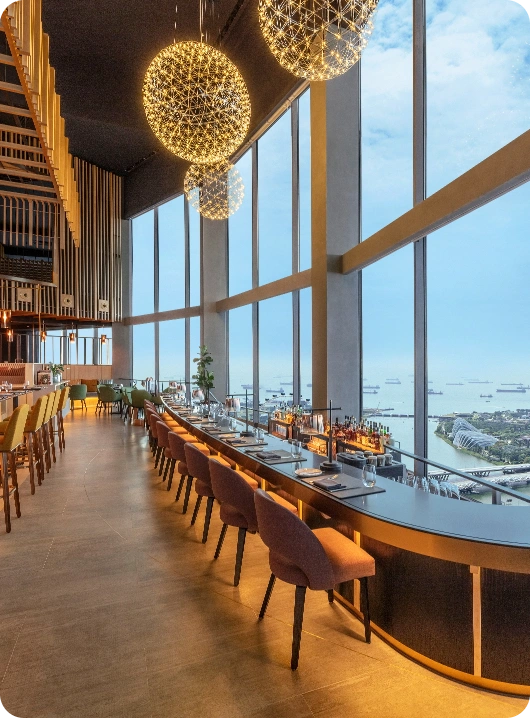
Transforming SKAI Restaurant & Bar, Fairmont & Swissôtel The Stamford Singapore
ELEVATED VIEWS,,
ELEVATED REVENUE.
+$435,309
Additional revenue, first 12-months.
“HyperHotels has transformed our business. They instill confidence in planning, development, and reporting. Without them, we’d still be struggling with internal challenges. They offer clear, real-time insights and accountability, ensuring we’re on the right track with website management and SEO. I highly recommend them for a clear and confident web presence.”

BEN JAMIESON
Director of Sales
Pullman Sydney Airport
Director of Sales
Pullman Sydney Airport