
Transforming Sheraton Grand Mirage Gold Coast
When AI Recommends Your Hotel, Whose Website Gets the Credit, and the Booking?
Michael MacDonald
Director at OmniHyper
Nov 27, 2026
9 MIN READ
When AI Recommends Your Hotel, Whose Website Gets the Credit, and the Booking?
In two recent hotel presentations, one slide drew more reaction than any other. It was not the visibility score, how they stacked up against their competitors, or even the direct revenue opportunity. It was the slide showing where AI got its information when it recommended the hotel.
Both hotels belong to global hotel groups, and each has its own property website, often called a microsite or vanity site, alongside its pages on the brand website. When AI named Hotel 1, its microsite accounted for 10 of the 20 citations. For Hotel 2, it was 18 of 30. Neither hotel’s brand website appeared among the citations in those answers.
Both teams were surprised. Both were also in the middle of conversations about the future of that microsite. Suddenly they had something they had not had before: evidence of the job it is doing today.
What We Found in Two Hotels
For each hotel, we asked 30 guest-style questions on each platform: ChatGPT, plus Google AI Overviews for Hotel 1 and Google AI Mode for Hotel 2. We then counted every website cited in the answers that named the property.
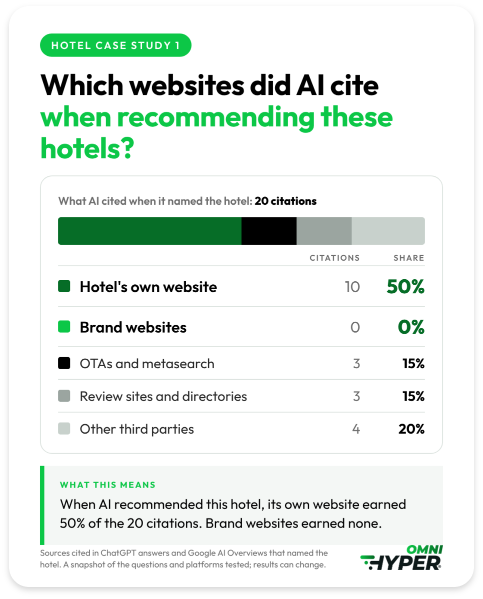
Hotel 1: the hotel’s own website earned 50% of citations. Brand websites earned none.
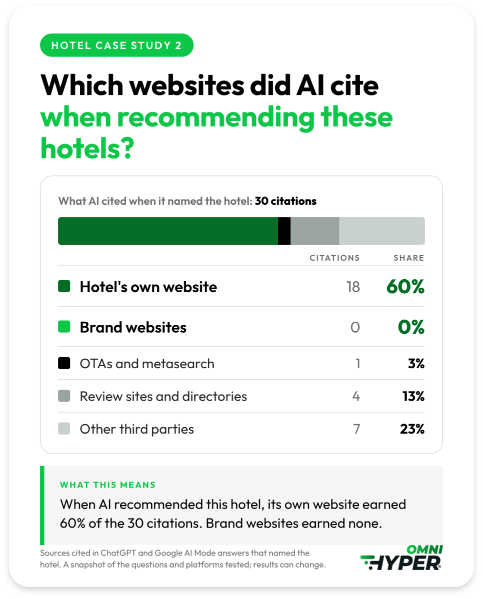
Hotel 2: the hotel’s own website earned 60% of citations. Brand websites earned none.
Being named is not the same as having your own website cited. Hotel 1 was named in 14 answers, and 4 of them cited nothing from its microsite. For Hotel 2, it was 10 of 27. In each of those answers, the guest was sent somewhere else to learn more. These results reflect the questions and platforms we tested on the day, and AI answers can change.
Being the Answer Is Only Half the Job
When a guest asks AI where to stay, AI names a hotel and cites a website. The citation gives the guest a place to go next.
I saw this recently while planning a work trip. I asked AI for a city-centre hotel and it gave me a clear first choice, but the link behind that recommendation was an OTA. The hotel won the recommendation. The OTA got the click, and possibly the commission.
Why a Microsite Can Earn the Citation
Hotel microsites are often dismissed as vanity sites. In these two analyses, the so-called vanity site was the most cited source when AI recommended the hotel. That is not vanity. That is the hotel’s front door in AI search.
The questions guests ask AI are specific. In our analyses they included:
- Which hotels suit a sports team needing twin rooms and bus parking?
- Which hotels in the shopping district have an outdoor pool?
- Where can I stay near the medical centre?
A property website can answer these questions in detail. When ChatGPT was asked which hotels suit teams needing twin rooms and bus parking, it named Hotel 2 first and cited its microsite. Asked about hotels with an outdoor pool, it named Hotel 1 and cited the pool page on its microsite.
At both hotels, guests who clicked through from the microsite could still book direct through the brand’s booking engine. The brand gets the booking either way. The question is who gets found first.
Why It Pays to Act Now
It is tempting to wait for the brand to solve AI search. But brand decisions are made for whole portfolios and take time, while guest behaviour is changing now. At a recent owners’ session, more than half of the hotels in the room had not yet assigned anyone to look after AI search. The hotels that act now set the answers their competitors will have to compete with.
What It Is Worth
Visibility is interesting, but revenue moves budgets. Every analysis ends with a directional estimate built from the hotel’s own search demand, occupancy, average daily rate and length of stay. For these two hotels, the potential direct room revenue came to:
- Hotel 1: about 13% to 25% of current room revenue
- Hotel 2: about 6% to 11% of current room revenue
Part of that is new business in rooms that would otherwise sit empty. The rest is guests the hotel already wins moving from OTAs to direct, keeping commission that would otherwise go to an OTA.
How to Check Your Own Hotel
Two things are within any property team’s control today:
- Check which websites AI cites when it names your hotel. Test the questions your guests actually ask, in both ChatGPT and Google, as the answers often differ.
- Publish clear answers to the specific questions guests ask. Room types, group needs, facilities and distances to what guests are visiting, on your own website, with a clear route to book.
When AI recommends your hotel, which website does it cite? Our complimentary AI Search & Commercial Opportunity Analysis shows where your hotel appears, which sources AI links to and the direct revenue opportunity in your own numbers. It is open to any hotel, branded or independent, and you keep the findings whether or not you work with us.

Michael MacDonald
Director
With 25+ years in hotel digital marketing, Michael has driven success for Accor, IHG, and Marriott worldwide.
Transforming Sala Thai at Santiburi
Spicing up the
BOTTOM LINE.
$620,779
Achieved in the first 12-months.17x ROI.
“We have seen an increase in external capture during both lunch and dinner, with external covers now contributing close to 70% of Boda’s capture.”

ZAC LUMSDEN
General Manager
Pullman Auckland Hotel & Apartments