
Transforming InterContinental Sydney Double Bay
Taking the Budget to Owners: How to Explain Digital Marketing Investment in Commercial Terms
Nick Hollows
Partnership Director
Sep 15, 2026
17 MIN READ
Taking the Budget to Owners: How to Explain Digital Marketing Investment in Commercial Terms
By the time the hotel budget reaches owner review, the conversation has changed. The digital marketing line items have already been reviewed against the budget guideline, shaped by the hotel team, included in the first draft, and supported with commercial evidence for head office review. Now the question becomes more direct: why should the owner approve the spend?
This is where digital marketing needs to be explained in commercial terms. Owners are not usually looking for a technical explanation of SEO, AI Search, hyperlocal visibility, paid media, metasearch or F&B destination marketing. They want to understand what the investment will do for the asset. Will it help grow direct revenue, reduce reliance on higher-cost channels, support rate, occupancy or total revenue, protect the hotel from losing demand to competitors and OTAs, and be measured properly?
Owners do not need to understand every technical detail of a digital marketing program. They need to understand the commercial problem it solves, the value it can protect or create, the risk of doing nothing, and how success will be measured.
The budget guideline gives the framework. The hotel team gives the commercial case. Owner review is where that commercial case needs to be at its clearest.
This article is part of The Hotel Budget Approval Guide
This article is Guide 5 in The Hotel Budget Approval Guide, a five-part series designed to help hotel teams prepare, structure, support and explain digital marketing investment through the annual budget process.
The full series includes:
- The Hotel Budget Approval Guide: How to Prepare Digital Marketing Line Items Before the Review Cycle Begins
- When the Budget Guidelines Arrive: How Hotel Teams Should Review Their Marketing Levers Before Building the Budget
- Building the First Hotel Budget Draft: How to Turn Digital Marketing Ideas into Defensible Line Items
- Preparing for Head Office Review: How to Support Digital Marketing Budget Lines with Commercial Evidence
- Taking the Budget to Owners: How to Explain Digital Marketing Investment in Commercial Terms
Each guide follows a different stage of the process, from the release of the brand budget guidelines through to hotel-level drafting, head office review and owner approval.
This final guide focuses on the owner conversation: how hotel teams can explain digital marketing investment in a way that connects to revenue, margin, risk, channel mix and asset performance.
Owners approve commercial logic, not marketing activity
A common mistake in owner conversations is to explain digital marketing by the activity being performed. SEO, AI optimisation, hyperlocal marketing, paid media and F&B marketing may all be accurate descriptions, but they are not always enough for owner approval.
Owners need to understand the commercial logic behind the activity. The conversation should not be, “we need budget for AI Search.” The stronger conversation is, “we need to protect and grow direct booking visibility because guest discovery is moving into AI-led search, and OTAs are increasingly positioned to capture that demand if the hotel is not visible or cited directly.”
That shift matters. A marketing activity sounds like a cost. A commercial logic sounds like an investment decision.
Start with the business problem, not the platform or the technology. Owners understand declining direct bookings. They understand rising OTA reliance. They understand soft weekday occupancy. They understand restaurants and bars that need more external demand. They understand competitors taking market share.
If the hotel is asking to reallocate traditional SEO spend into AI Search, the problem is not that SEO was wrong. The problem is that guest discovery has changed.
A hotel may still rank well in traditional search but receive fewer direct clicks because guests are finding answers through AI-led summaries, maps, reviews, OTAs and other third-party sources before they reach the hotel website. If the hotel is not visible, cited or accurately represented in those environments, direct demand may be lost before the booking engine is even reached.
That is the problem. AI Search then becomes the response.
The owner should not have to work out why the line exists. The hotel should make the problem clear first.
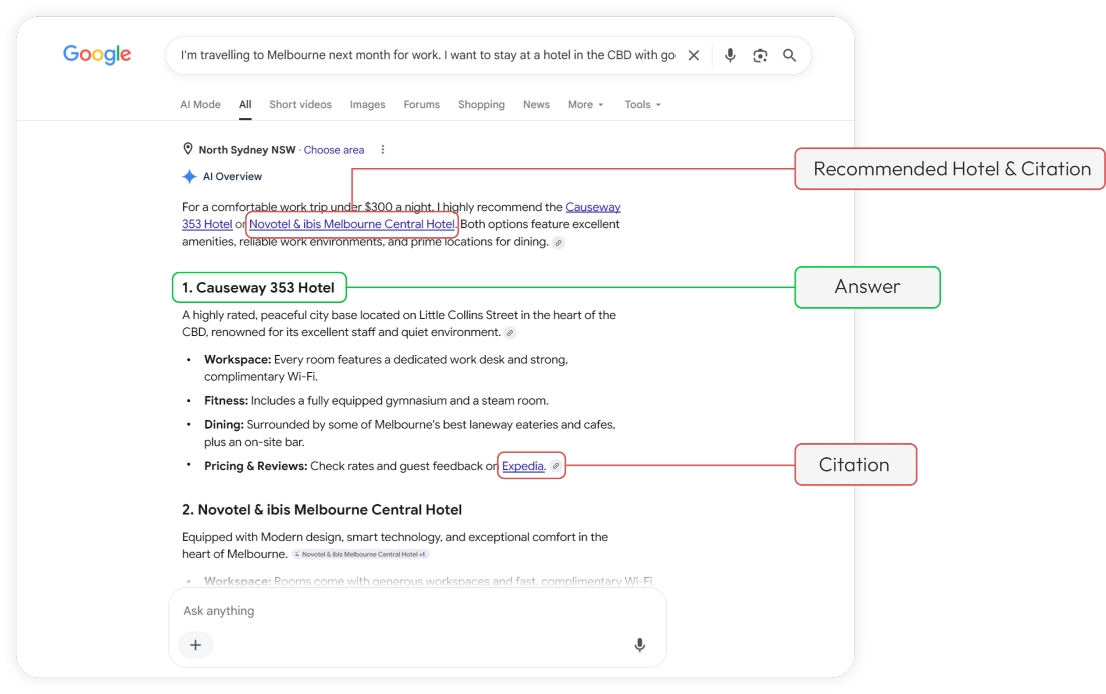
This visual explains the owner problem simply. Even if AI recommends the hotel, the booking opportunity can still go to an OTA if the OTA is the cited source. Being recommended is not enough.
Translate digital activity into owner language
Hotel owners do not need a technical lesson in every digital channel. They need a clear translation between the digital activity and the commercial outcome.
Instead of saying “AI Search optimisation,” say “protecting direct booking visibility as guests move into AI-led discovery.”
Instead of saying “Hyperlocal SEO,” say “capturing local demand from guests, diners and visitors searching near the hotel.”
Instead of saying “F&B destination marketing,” say “helping the restaurant or bar compete for external guests, not only in-house hotel guests.”
The technical detail can still sit behind the recommendation. But the owner-facing explanation should focus on why the investment matters commercially.
Put digital marketing on the same footing as distribution cost
Digital marketing should not only be reviewed as marketing spend. For owner approval, it should also be compared against the cost of acquiring demand through other channels.
This is especially important when the hotel is trying to reduce OTA reliance. OTA commission is often accepted as a cost of doing business. But direct booking visibility, AI Search, hyperlocal visibility, CRM, metasearch and owned digital infrastructure are also acquisition costs.
The difference is that direct digital investment can create longer-term value. OTA commission is paid every time the booking happens. Owned digital visibility can continue to support future bookings, direct guest relationships, first-party data, repeat stays, restaurant demand and lower acquisition costs over time.
One of the easiest ways to make digital marketing more owner-ready is to compare channels by net value rather than headline booking volume. A channel that delivers more bookings is not automatically the most profitable channel if the acquisition cost is higher, the cancellation rate is higher, or the guest relationship is controlled by a third party.
The questions are the same ones used to evaluate distribution. What does it cost to acquire the booking? What revenue remains after channel costs? Does the channel help the hotel build a direct guest relationship and reduce future acquisition costs?
That is an important owner conversation. The question should not only be, “what does this marketing program cost?” The better question is, “how does this cost compare to the cost of acquiring the same demand through OTAs, paid channels or third-party platforms?”
That framing changes the discussion. Digital marketing is not just a cost line. It is part of the hotel’s cost of acquisition strategy.
Connect the investment to revenue, margin or risk
Digital marketing investment is easier to explain when it is connected to one of three commercial outcomes: revenue, margin or risk.
Some lines are about revenue growth. This may include direct bookings, restaurant bookings, external covers, private dining enquiries, event enquiries or destination venue demand.
Some lines are about margin protection. This may include reducing avoidable OTA reliance, improving direct channel visibility, supporting brand.com or owned website engagement, and shifting demand away from higher-cost channels.
Some lines are about risk reduction. This may include declining organic traffic, poor AI visibility, competitor dominance, weak tracking, poor local presence, incorrect hotel information, or a digital presence that no longer supports the hotel’s commercial plan.
The strongest owner cases often connect to more than one. An AI Search and Direct Booking Visibility line may support revenue growth by increasing qualified direct demand, margin protection by reducing OTA leakage, and risk reduction by ensuring the hotel is visible and accurately represented in AI-led discovery. A hyperlocal or F&B destination line works the same way, adding local demand and external covers, generating more direct booking actions, and reducing dependence on in-house guests or paid campaigns.
Risk is also where the cost of doing nothing belongs. Guide 4 covered how to show head office what happens if a line is not funded. For owners the point is shorter and sharper. The question is not only what the hotel may gain if the investment is approved. It is what the hotel may continue to lose if the issue is not addressed.
Owners do not need digital marketing framed as a trend. They need it framed as a revenue, margin or risk decision.
Use evidence owners can understand
Owner conversations become stronger when the hotel can show the issue in practical commercial terms. The evidence does not need to be complicated. It needs to support the decision.
The owner case should not simply say that AI Search is important. It should show what has changed. A practical evidence set may show that traditional rankings have improved, but web direct bookings and web direct revenue have declined. That tells a very different story to “SEO performance is up.” It shows that rankings alone may no longer be enough to protect direct demand.
This is important because it reframes the conversation. The hotel is not saying the previous SEO work was wrong. The hotel is saying the budget needs to evolve because the way guests discover, compare and choose hotels has changed. AI Search and Direct Booking Visibility then become a response to commercial evidence, not a new marketing trend.
The same approach applies to hyperlocal visibility. If the hotel wants owners to approve investment for a restaurant, bar or venue, the evidence may include map visibility, Google Business Profile actions, calls and direction requests, local ranking movement, external covers or gaps against local competitors.
Do not bring every metric. Bring the metrics that support the decision.
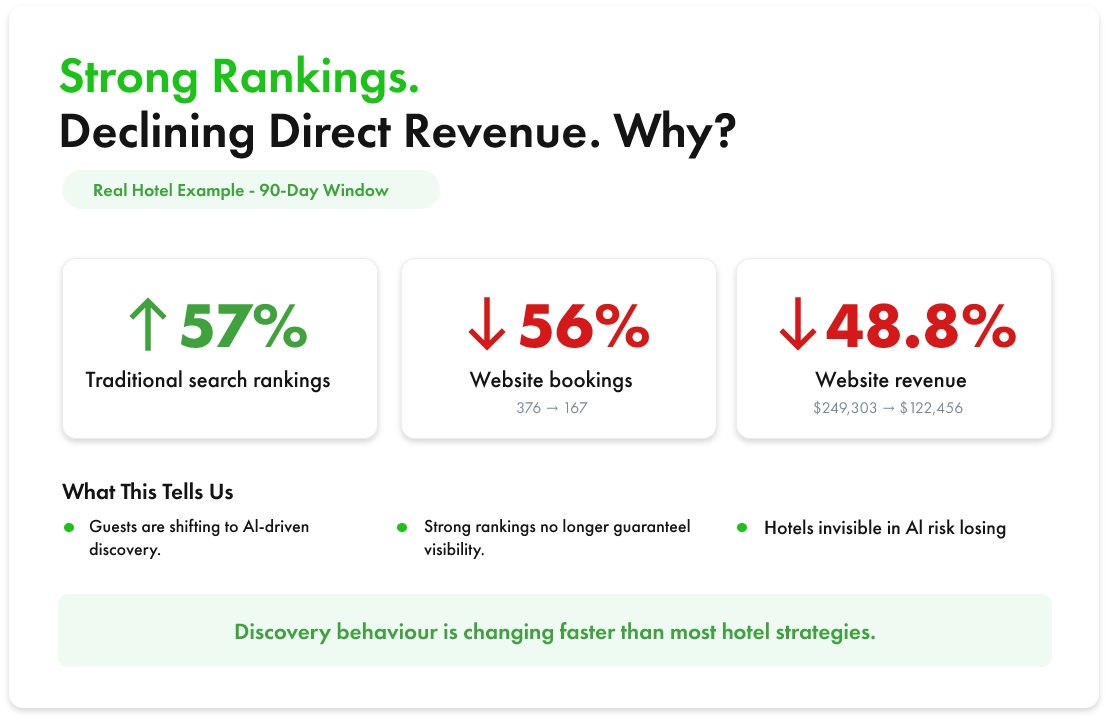
This is the strongest proof point for explaining why owners may need to approve a shift from traditional SEO to AI Search. The slide shows traditional rankings improving while web direct bookings and web direct revenue decline. Strong rankings do not always protect direct revenue.
Explain why now
One of the most important owner questions is timing. Why does this need to be funded now?
That question should be answered directly. A digital marketing line may need to be funded now because the hotel’s commercial targets have changed, a new segment is being targeted, OTA reliance is increasing, a restaurant or bar is expected to grow external demand, or current digital visibility is no longer strong enough to support the commercial plan. It may also need to be funded now because guest discovery has shifted and the hotel is losing visibility earlier in the booking journey.
This is particularly important for newer areas such as AI Search. If AI Search is presented as something new and interesting, it may be delayed. If it is presented as a current visibility and direct booking risk, the timing becomes easier to understand.
The argument is not, “we should do this because AI is new.” The stronger argument is, “we should do this because guests are already using AI-led discovery, competitors and OTAs are already influencing those results, and the hotel needs to understand and improve its position before more demand is lost.”
De-risk the recommendation
When an owner does not fully understand a marketing program, the hotel team should make the decision feel controlled. That means showing how the investment will be managed.
A new or unfamiliar digital marketing initiative may be easier to approve when it has a defined scope, clear measurement, realistic timeline and review point. For example, the hotel might propose a 90-day review period, a capped budget, a clear reporting structure, and a decision point to continue, adjust or stop. This is especially useful for AI Search, hyperlocal visibility or newer property-led digital programs that may not be fully understood by owners.
The questions prepared for head office review in Guide 4 already do most of this work, so the owner version does not need to be rebuilt from scratch. Showing the scope, the measurement and the review point helps the owner see that the recommendation has been considered properly. It also shows that the hotel is not asking for open-ended spend. It is asking for a controlled investment tied to a commercial objective.
Be clear about what success will look like
Owner approval is easier when success has been defined before the investment is approved. The hotel should not simply say the program will improve performance. It should explain how performance will be reviewed, which data sources will be used, and what commercial signals would indicate that the investment is working.
This is particularly important for AI Search because traditional last-click reporting may not show the full value of the program. A guest may discover the hotel through an AI-generated answer, compare it against competitors, see the hotel cited through an owned or third-party source, return later through brand search, and only then complete the booking. If the hotel only looks at the final click, it may miss the influence that happened earlier in the journey.
No single metric can prove attribution in modern search. When multiple independent data sources move in the same direction, they create a stronger commercial picture. OmniHyper’s AI-driven search case study reviewed performance across Google Analytics 4, Google Search Console, Google Business Profile, AI Source visibility reporting and the hotel’s own commercial reporting. The full method is set out in How to Prove AI Search Actually Works for Your Hotel.
The measures should match the purpose of the investment. Not every line will produce immediate revenue, and not every booking can be attributed cleanly. That should be acknowledged rather than hidden. An AI Search program may first need to improve visibility, owned citation share and accuracy of representation before it shows in last-click revenue. Owners value realistic assumptions. The goal is not to overpromise. It is to show that the recommendation is commercially considered and measured in a way that matches the purpose of the line.
The video below summarises how AI Search performance was reviewed across visibility, direct demand, channel shift and commercial outcomes, helping translate a newer digital marketing program into the type of evidence owners can understand.
Use an owner-ready approval structure
The final owner conversation should make the decision easy to understand. A useful structure is:
- The problem: What is happening?
- The impact: Why does it matter commercially?
- The recommendation: What investment is being requested?
- The evidence: What supports the case?
- The expected outcome: What revenue, margin or risk outcome does this support?
- The risk control: How will the investment be managed?
- The review point: When will performance be assessed?
This structure keeps the conversation focused. It also helps hotel teams avoid a common mistake: explaining too much about the channel and not enough about the commercial decision.
A well-structured digital marketing budget line should not feel like a separate marketing request. It should feel like part of the hotel’s commercial plan.
Owner approval is about confidence
Owners approve budget lines when they have confidence. Confidence that the line supports the commercial plan. Confidence that the hotel understands the problem. Confidence that the recommended lever is appropriate. Confidence that the evidence has been considered. Confidence that the investment will be measured. Confidence that the hotel understands the trade-off if the line is not funded.
That is why the owner stage is not just about asking for approval. It is about giving the owner the confidence to approve. Digital marketing is no longer a side conversation in the hotel budget. It influences how guests discover the property, how direct demand is captured, how OTA reliance is managed, how restaurants and bars compete, and how the hotel protects visibility in a changing search environment.
When explained only as activity, it can look like cost. When explained in commercial terms, it becomes part of the asset performance strategy.
That is the goal of the owner conversation. Not to defend marketing. To explain the commercial value of the investment. Would you like support preparing digital marketing budget lines for owner approval?
If your hotel is preparing for owner review and needs help explaining digital marketing investment in commercial terms, OmniHyper can help structure the business case.
This may include AI Search visibility, direct booking growth, OTA channel shift, hyperlocal visibility, or F&B as a standalone destination venue.
For hotels specifically reviewing AI Search visibility, OmniHyper can provide an AI Visibility and Commercial Impact Report. This assessment helps hotel teams understand:
- How visible the hotel is across AI-driven discovery
- Whether the hotel, brand.com, OTAs or third-party platforms control the narrative
- How the hotel compares against its competitors
- Where direct demand may be leaking into indirect channels
- The potential direct revenue opportunity available
For dedicated AI Search visibility assessments, request an AI Visibility and Commercial Impact Report.
For wider conversations, including Hyperlocal assessments, digital marketing reviews, budget support or general enquiries,

Nick Hollows
Partnerships Director
Nick brings 15+ years of experience working with hundreds of hotels worldwide, helping drive performance and direct revenue. As Partnerships Director at OmniHyper, he’s known for his strategic and commercially focused approach.

Transforming Sala Thai at Santiburi
Spicing up the
BOTTOM LINE.
$620,779
Achieved in the first 12-months.17x ROI.
“We have seen an increase in external capture during both lunch and dinner, with external covers now contributing close to 70% of Boda’s capture.”

ZAC LUMSDEN
General Manager
Pullman Auckland Hotel & Apartments